Part 1 of this two-part article provided a brief history of British clubs in European competition and the context of the Croydon Pirates’ entry into the 2005 Cupwinners Cup. This second part tells the story of what happened on the Pirates’ tour. The quotes and memories are taken from recollections shared over email correspondence approximately four years ago. Particular thanks go to Ryan Kirkby, Evan Donovan, Charlie Caskey, Alec Gatrell, and Andy Kulina. Details for the game against Regensburg are taken from a copy of the official scorecard that was kindly lent to me by Dave Ward.
——————————————————————————————————————-
During 2004 and the first half of 2005, the Croydon Pirates had built up a reputation in the domestic league of playing high-quality baseball despite hindering themselves with hangovers, late arrivals at the ground on game days, and a complete absence of a training programme. This party-hard, play-harder ethos was something the Pirates had no plans to change while representing the country on the Continent.
While this article should in no way be seen as an endorsement or celebration of this approach, I cannot help but look back at those years — when I was starting out as the team’s scorer — with admiration. The main reasons for this are as follows. First, the Pirates displayed comparatively little arrogance towards their opponents (e.g. there was never any hint that their hangovers and minimalistic pre-game preparations were intended to imply they were not stretched enough by the competition). Moreover, they always respected the game when they were playing it.
The 2005 European Cupwinners Cup was held in Antwerp, Belgium, from 14 to 18 June. The co-hosts for the event were the Mortsel Stars and the Borgerhout Squirrels.
The Pirates were drawn in a group with:
- Regensburg Legionäre (a professional squad from Germany);
- Dinamo Bucharest (a Romanian side who had stormed to victory in the previous year’s qualifying event with a 5-and-0 record); and,
- Rojos de Tenerife (a team from Spain who, like the Germans, were professional, but who also happened to be the defending champions).
A top-two finish would see the Pirates qualify for the semi-final stage. In order to give themselves a decent shot at this, they would need to do something that no British club had done before at an A-Pool event: win more than one game. In fact, in six previous attempts, British clubs had amassed only one win in total.
Leaving Croydon
For a short time, it looked liked the Pirates might not make it to Belgium at all: they came close to getting stuck, in a literal sense, in the outskirts of London.
On the day before the start of the tournament, at the meeting point of East Croydon, 14 players jumped into a minibus that the team had hired for the trip. This was driven by manager Dave Ward. His first leadership challenge came while still in Croydon, and this was to guide the team bus between two metal posts forming a traffic width restriction. It seemed, temporarily at least, that the vehicle had become wedged in, but it was slowly worked free and the team breathed a collective sigh of relief. Still, the delay this caused — combined with the team’s loose application of meeting-up times and their need to stop (on more than one occasion) to pick up beer — meant that they were in danger of missing the Channel ferry. Once more, though, fortune was on the Pirates’ side and they just reached the embarkation point in time.
The ferry crossing, naturally, provided an opportunity to consume more beers. Therefore, by the time the bus had reached the Continent, its passengers were in a rather inebriated state. By now, the group was keen to reach its destination, and stops were thus at a premium. Rumours later surfaced that the large gaps between toilet breaks forced one of the passengers into having to find a second use for a beer can.

Wrestling Pirates, on the way to Antwerp
When the bus did finally stop, the players made the most of the open air. Wrestling was one of the preferred activities, while another was canal jumping. Sadly for the two players who signed up for the latter, the canal was wider than they’d judged it to be and they thus both splashed into the water. It was reported that a funny smell lingered around the pair for the rest of trip.
The team finally neared Antwerp, but the fun was not yet over. The Ibis hotel was not as easy to find as the Pirates had hoped and they began driving round in circles. Two of the passengers on the backseat managed to spot the hotel during the circling, but their calls were not heeded. Thus, not once but twice the team drove straight past the hotel. They finally pulled up at their accommodation 45 minutes after they had first passed it.
At last, the Pirates had arrived.
The pre-tournament team meeting
There was one main topic for discussion at the Pirates’ pre-tournament team meeting. How were they going to get through a tournament that involved five consecutive game days with only three established pitchers? While that conversation continued — without sign of an answer — Byron Cotter had his own concerns, quietly bemoaning the absence of regular catcher Wesley Tim. Cotter was staring at five straight days wearing the tools of ignorance. Complicating matters further was that Cotter was one of the established pitchers.
Game one (versus Rojos de Tenerife)
On the Tuesday morning, Croydon relaxed outside their hotel waiting for their transfer to the ground. They were dressed in a mixture of team tops and rocker T-shirts, blue jeans and board shorts. They boasted an assortment of aviator shades and flip-flops and an array of dubious facial hair.
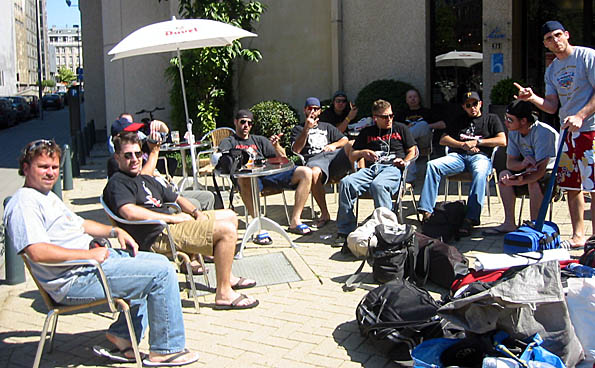
The Pirates waiting to be collected form their hotel ahead of the opening game
The transport provided by the tournament organisers — the Pirates were delighted to learn — was a luxury coach, which the squad eagerly piled on to and made their own, spreading themselves out to take full advantage of the space. They were soon surprised, though, to be stopping outside another hotel. In contrast to their budget lodgings, this was 5-star accommodation. They had to sheepishly squash up into the back as a 40-strong ensemble of players and staff from Rojos de Tenerife climbed onto the coach. The professional Spanish side was somewhat bemused by the dress code and small size of this British baseball team.

Pre-game conference ahead of Croydon’s tournament opener against Rojos de Tenerife
In the game, the Pirates far from disgraced themselves, eventually falling 8-1. The Rojos’ starter, a Croydon player estimated, was throwing in the 90s. For Croydon, Ian Bates pitched commendably and Ryan Kirkby was effective in relief, keeping the scoreline respectable. The Pirates also saw their opponents’ closer, greeting him with back-to-back hits (courtesy of Andy Kulina and Charlie Caskey). The contest served as excellent preparation for the days to come, although the Pirates quickly tried to forget an enormous bomb hit by one of the Rojos’ many powerful sluggers, which was still rising as it crossed the fence.
After the game, Croydon extended an invitation for the Tenerife team to join them for drinks. The biggest player in their line-up spoke for the team when he said.
I do not drink. My body is my temple
To this, one of the Pirates replied:
Oh yeah? My body is my rubbish bin.
That evening, following the first session of the Pirates’ beloved instant-justice Kangaroo Court system, the team headed out for dinner — where Alec Gatrell was dared to snort a line of wasabi — and then moved on to a laundromat. At the end of their first game, the Rojos had tried to swap jerseys with the Pirates, but this would have left Croydon without a uniform for the rest of the tournament. Their single set of yellow shirts needed to be carefully nursed through the five-day event, and this necessitated visits to the soap ‘n’ suds. One consolation was that the laundry they found had its very own beer-dispensing vending machine.
Game two (versus Dinamo Bucharest)
The Pirates were again collected by the bus ahead of their second game in the tournament. This time, though, their coach-mates (Technika Brno, a Czech team in the other half of the draw) were picked up not from a 5-star hotel but from a campsite; they were sleeping in tents. The British team had gone from paupers to kings and they even found themselves with the thick end of the wedge on kit. One Pirate described the Czechs’ outfit as bad softball uniforms. Despite the many contrasts between the Czechs and the Spaniards, Technika Brno’s players showed the same look of bemusement as Rojos de Tenerife had when they boarded the coach to find another team wearing rocker T-shirts and sporting bad facial hair.
Croydon found worthy opposition in the Romanians. The game was tied 1-1 going into the ninth, at which point the Pirates exploded for 4 runs, two of them courtesy of a Rhys Dixon long-ball. Sam Whitehead, the Pirates’ starter, pitched a scoreless half in the bottom of the ninth to seal a stellar complete-game victory.
The 5-1 victory set up a second-place decider with Regensburg, who had cruised past the Romanians 10-0 but then been thumped by Rojos de Tenerife 17-zip.
The win was celebrated with the purchase of beer from the bar at the ground. The locals stared in disbelief as the team bought and drunk it by the crate-load and held another Kangaroo Court.
Free time
Now that the Pirates had a win under their belt they could relax (even more).

Catching up on sleep: Ian Coward (left) and Billy “Snooze” Richardson (right)
While they were not eating food or washing their uniforms at the laundromat, the Croydon players could be found catching up on sleep, playing beer pong, and hitting the town.
On one occasion the team encountered a Hen’s Night party. Of the three tasks the “hen” had been challenged to complete, only one can be repeated here. She was carrying a notebook with her and had been set the goal of getting people to write “I love you” in as many languages as possible. Alec Gatrell, an Australian, grabbed the book and wrote:
The Pirates playing beer pong
You’re a top sheila with great norks.

When the hen looked confused, he replied:
Hearing that from an Aussie guy is as close to “I love you” as a woman is ever gonna get.
There was also much time for the inevitable telling of tales from baseball teams past. Billy Richardson, a natural orator, reeled off story after story on how at inter-state tournaments back in Australia, all the teams would be trying to nick each other’s gear.
Even when the team was attempting to be serious, things descended into comedy. During one warm-up session a couple of the players were running a soft-toss drill but unfortunately one of the hits ricocheted off a board at the base of the netting and straight back at the player, landing a direct blow on that most sensitive of areas. Faced with such pain, the only course of action the player had open to him was to fall to the ground like a sack of spuds, which — naturally — caused much amusement for the Pirates around him.
Game three (versus Regensburg Legionäre)
Croydon got to the ground early for the must-win contest against Regensburg. Thus, when the Germans arrived to begin their warm-up — already dressed in their uniforms — they found Pirates scattered all over the field. Some were baking themselves in the sun in front of the dugout reading materials of a top-shelf nature. The marginally more active members of the party were playing baseball golf in centre-field.
Regensburg must have wondered what these bums were doing on the baseball field. However, by game time, the Pirates were ready and locked-in for what was arguably the most important contest in the club’s history up to that point. A flag with crossbones and an eye-patch-wearing skull stared out at the Germans from the Croydon dugout.

The Pirates make the dugout a home from home, versus Regensburg
The Pirates, who were the visitors, sent Ian Bates to the hill on two days’ rest. His opposite number was Rodney Gessman, an 18-year-old from Hawaii who two years later would be signed by the Minnesota Twins for a rookie-ball Gulf Coast League assignment. Regensburg’s shortstop in the game, 17-year-old Ludwig Glaser, was also a rising star: three years later he was playing rookie ball for the Arizona League Angels, and he later appeared in two games for Germany at the 2012 World Baseball Classic Qualifier.
Bates gave the Pirates their first baserunner, getting hit by a pitch batting third in the first inning. He promptly stole second and was then driven in by a Rhys Dixon single. In the bottom half of the frame, Croydon’s run scorer gave up a lead-off single, to Gessman, but then retired three straight to leave the runner stranded.
In the Pirates’ second set of at-bats, Charlie Caskey drew a walk, Byron Cotter singled, and Rob Mason laid down a one-out sacrifice bunt, before Greg Stefan doubled home both baserunners and was then himself driven in by Sam Whitehead. The Germans were again blanked in the bottom of the inning. Croydon led their professional opponents 4-0 and were making it look easy.
Cotter singled again in the third but Croydon left runners at first and third and did not score. Regensburg then scored their first run of the game, on back-to-hits with two outs. Neither team scored in the fourth, and Croydon were stifled once more in the top of the fifth.
In the bottom of the fifth, Bates finally began to crack, showing fatigue from pitching against Rojos de Tenerife. He began the inning with five straight free passes. The fifth of these brought Regensburg to within 1 run of the Pirates, who were forced to now turn to self-confessed junkballer Rhys Dixon. He started shakily, sandwiching a fly-out to centre-field between two walks. This put the Germans 5-4 ahead, and they still had the bases loaded. However, Dixon managed to cauterize the bleeding with two straight strike-outs.
The Pirates quickly restored parity, with singles from Evan Donovan and Mason batting Caskey round for a run with no outs. But the contest, which was threatening to head towards a free-scoring finish, suddenly switched into lock-down mode. The top of the Pirates’ order made three straight outs to squander a bases-loaded situation and there was only one other baserunner before the ninth inning. Philip Hoffschild singled in the seventh but was gunned down by Cotter (the Pirates’ catcher threw out two in the game and did not give up a steal).
Croydon were in the ideal spot in the batting order to start the ninth. They had their lead-off man, Stefan, up first, and he obliged with a single. He was a fiendish base-stealer during his short spell in domestic baseball in Britain, but Croydon were taking no chances and Whitehead sacrificed him across to second. Bates picked up his first single of the game to push Stefan over to third with one out. Dixon did what was asked of him and lofted a fly-ball into left-field, to put the sacrifice fly on. Stefan just beat the tag at the plate to put the Pirates ahead once more.
In the bottom of the ninth the Germans also got their first man up on base. While conventional wisdom suggests that the home team should play to tie in such a situation, they did not want to give away one of their outs. This proved to be a costly decision when the next batter up found the glove of Whitehead, Croydon’s shortstop, who combined with Stefan to turn the silkiest of double-plays and put a very different complexion on the inning. With the bases now empty, Dixon induced a fly-out to right to seal Croydon’s 6-5 victory, and the team’s qualification through to the semi-finals.
Dixon’s winning effort involved five innings of relief with two hits, two free passes, four strike-outs, eight outs by way of fly-balls and pop-ups, and — crucially — no runs against his name. He had also driven in the game-deciding run in what was arguably the greatest victory in European club competition for a British team.
Finances
After the Regensburg game, Andy Kulina, an American on the Pirates squad, went across to the opposition camp to see if he could swap a British Baseball Federation ball for a German league one. A fellow American in the Regensburg line-up happily accepted and quietly reflected to his countryman Kulina: “Hey, at least we’re still getting paid to play.” It was only then that the Germans learned they had been beaten by a fully amateur side. As Kulina went on to explain how the Pirates actually forked out £140 each year in subs to be able to play, it began to sink in.
Later, the player was heard moaning to his team-mates:
We got beaten by a bunch of bearded truck drivers.
Economizing, except where beer was concerned, was certainly a theme from British baseball that the Pirates carried on to the Continent. At the hotel, for instance, it became a morning ritual for each player to make up ham and cheese rolls from the breakfast buffet and carefully wrap them in their napkins to create a free lunch.
Despite the team’s best efforts, one of the players was left with a major dent in his assets when the gods of irony struck a cruel blow. Billy Richardson fell victim, as he had a brand-new Sam Bat swiped.
Semi-final (versus Konica Minolta Pioniers)
After three tough games, the Pirates would be pitching on fumes alone had they not called for re-inforcements, which came in the shape of slugger and part-time knuckleballer Jeff McDonald. (Later in the year, he would hit an extra-innings walk-off homer to seal a second national championship for the Pirates, having got the victory on the mound in the previous season’s deciding contest.)
Pitching was not the only problem that Croydon had. The team was fatigued at every position. And they now had to face one of the top teams in Dutch pro ball. Thus, when the Pirates arrived at the ground and found a physio tent that had been set up for the Pioniers, a couple of the players could not resist slipping inside for a massage. This caused the Dutch team much confusion when they arrived at the tent for their own preparations.
For three innings the contest remained close. The Pirates did not score, but McDonald limited the Pioniers to 3 runs. In the fourth, the game began to get away from the Pirates, with the Pioniers adding a further 4 runs. Although Croydon responded with a pair of scores in the top of the fifth, the Dutch piled on three more of their own in the bottom of that inning.
In the sixth, McDonald was relieved by Evan Donovan, who was not a specialist pitcher. He walked a guy and hit two others before McDonald jogged back across from third to re-instate himself as pitcher and prevent things from getting uglier. In the end, the Pioniers triumphed 18-3. At least the Pirates could say that their three extra-base hits (two-baggers by Bates, Cotter, and McDonald) trumped the two doubles that the Dutch had amassed.

The Pirates shake hands with the Pioniers after the semi-final
Michael Duursma, who was the Pioniers’ lead-off hitter and shortstop in the game, appeared in four games for the Netherlands in the 2009 World Baseball Classic and also saw action in the remarkable 2013 Classic.
Going home
Now a completely spent team, Croydon lost 11-2 in the play-off with Belgian team Brasschaat Braves for third place. They stayed to watch Rojos de Tenerife play Konica Minolta Pioniers in the final, a tight game that the Spanish side prevailed in by a score of 6-4. After that the awards were given out, and the Pirates were surprised to learn that they got a trophy for fourth place. When theirs was awarded — the Pirates later recalled — a bigger ovation was given than that for the overall winners. The locals, who were at first perplexed by the Pirates’ antics, had been won over.
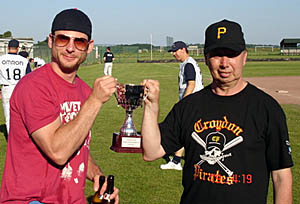
Charlie Caksey (coach; left) and Dave Ward (manager; right) hold the fourth-place trophy
The next morning it would be time to go home, although that was going to be difficult without the minibus the team had hired. Just as it had on the trip out, the minibus was going to provide a challenge on the way back. Dave Ward was stunned, on the evening after the final, to see that where he had last parked the vehicle was now nothing but an empty space.
At least it had not gone the way of Billy Richardson’s Sam Bat, for it had just been towed to a pound, owing to a parking infringement.
With their van recovered, the following morning they drove out of Antwerp, and on the outskirts of the city they saw the ball landing from the mighty home-run Rojos de Tenerife had hit against them back on the Tuesday.
Croydon would be back the following year, as they were invited by the Mortsel Stars — who had become fans of the Pirates during their semi-final with the Dutch giants — to play in a testimonial match for a retiring player.
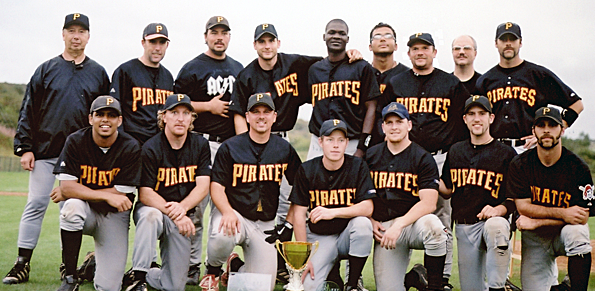
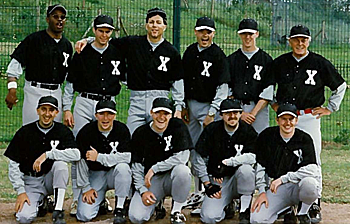
The Croydon Pirates’ 2005 European squad