Thank You For The A’s: Spring 2018

The road to Thursday 29th March and the Oakland A’s regular season opener against the LA Angels begins on Friday with a Spring Training game against the Angels.

We’ve not heard yet who will be playing in the opener, but in some respects that doesn’t really matter.

What matters is the A’s will be back out on the field and we can officially say goodbye to the winter and get back into the baseball swing of things.

Things to look out for in Spring

Given where the A’s are in their rebuilding plans, it’s no surprise that exciting new recruits are thin on the ground.

Stephen Piscotty is the most prominent off-season addition and I’m looking forward to seeing him in the green and gold.  Much as I’m trying to temper my ethusiasm, I have this hunch that he’s going to prove to be an inspired pick-up and quickly become a fan favourite.  This time last year he was one of the more intriguing young players in the Majors, not primed to be an MVP candidate or anything but someone who looked like being a core player with the Cardinals for years to come.

We all know 2017 was a tough year for Piscotty, both on and off the field, and the 2018 season will show us if that was a blip or if teams have made adjustments to him that he can’t find a way to adjust back to. I’m betting that he’ll settle in quickly and be just fine.

Other than that, we’ve got some new relievers to take a look at and some of the youngsters, especially early on this spring.

Dustin Fowler’s progress from knee surgery all sounds positive and fingers are firmly crossed that he comes through spring with no issues, as I suspect he’ll be the Opening Day start in centre field if so.  Jorge Mateo – another of the Sonny Gray return from the Yankees – has a slight knee injury but it wasn’t expected that he would head to Oakland with the club at the end of spring anyway.  He will get some work in, hopefully impressive Bob Melvin and the coaching staff along the way, then head to Nashville with Franklin Barreto to start the season in Triple-A.

The main performances to look out for concern the gaggle of arms that are competing for spots in the starting rotation.

MLB.com A’s beat writer Jane Lee wrote a piece on Nick Blackburn last weekend that included a telling quote from Melvin:

“Typically we’re not that big on Spring Training performances because they can fool you some,” A’s manager Bob Melvin said. “I even had great springs. I hit .300. Then there are other times when that’s all you have to go on.”

Whilst Kendall Graveman and Sean Manaea look certainties to be in the rotation, the oher three spots are all up for grabs and currently there doesn’t seem much to separate most of them other than how they look in spring.  Regardless, we’ll likely see all of the current contenders pitching in Oakland at some point this season.

Spring schedule

Click to see the full schedule

From Friday there are only two days, 2 and 14 March, on which the A’s are not playing a game until the day before the MLB season begins.

The A’s have 29 Spring Training games, plus the traditional three-game series against the Giants, and the vast majority of them are a 20:05 UK time first pitch.

Currently nine of the A’s Cactus League games, and the three Giants games, are scheduled to be broadcast on MLB.TV.  All of the rest will be available to listen to via radio coverage on MLB.TV or MLB At Bat.

A full schedule can be found by clicking on the image above.

A difference in 2019

We found out yesterday that the A’s 2019 Spring Training will be a bit different as Susan Slusser reported that the team will be opening the MLB season in Japan with the Seattle Mariners.

In the previous two times the A’s started in Japan, the games were at the end of March (28th and 29th in 2012) and so the team’s Spring Training was shortened to accomodate the travel.

The slightly disappointing part to the news is that it confirms that the A’s will not be one of the teams heading to London next year for the eagerly anticipated UK series; however, that was always likely to involve east division teams so it wasn’t expected that Oakland would be heading across the pond anyway.

The good news is that the games in Japan played by the A’s previously took place at 10 or 11 am in the morning UK time, so although you need to plan to be off work those days, it does mean the games are at a very convenient time for us.

And it gives US-based fans a chance to live the UK experience by watching games in the early hours of the morning!

No dates have been announced as yet, in fact no details are official at this point although you can count on Susan to have the facts, but it will be something else to look forward to for March 2019.

But let’s not wish away 2018 just yet.  We may not be expecting a play-off push this year, but there’s still going to be plenty to enjoy, not least watching and listening to our A’s simply being back out on the field again on Friday.
MLB Spring Training 2018

Major League Baseball will return to our screens this week as the pre-season period, known as Spring Training, gets underway from Arizona and Florida.

There are a handful of games on Wednesday and Thursday pitting MLB teams against college sides in exhibition contests before the Spring leagues – Cactus League in Arizona, Grapefruit League in Florida – begin on Friday.

No one should care about game results in spring, in fact most of the established players are usually out of the game and heading off to a golf course by the sixth inning, although understandably everyone would prefer to avoid racking up a run of losses and giving the fanbase a reason to get uppity.

In 2017, the Houston Astros went 15-15 in spring, whilst the LA Dodgers just edged past .500 with an 18-17 record, so the results can be forgotten as soon as they are in the record books.

There will be few cases across the Majors where a strong spring will help a player make the Opening Day roster, but that doesn’t always mean the player will stick around for long.  Pre-season games in baseball are similar to most other sports: you’re just looking to get ready for the season and hoping to avoid any injuries.

Watching and listening to the games

As a fan, the start of spring gives you a first chance to see players in their new uniform and the simple pleasure of watching – or listening – to some baseball after a long winter.

MLB.TV subscriptions include Spring Training games and, unlike 8-10 years ago, there is now a decent number of games being broadcast even though the majority of games are not televised (if a game’s not available on MLB.TV that simply means neither team’s regional network – nor MLB Network or ESPN – is broadcasting it so there is no TV feed for MLB.TV to show you).

The full list can be found in the MLB.TV Spring Training schedule.

Start times are listed in Eastern Time on that schedule. That’s normally 5 hours behind the UK (so a 1pm listed start is 6pm for us), although that will come down to 4 hours between 11 March and 25 March as the U.S. moves into daylight saving time two weeks ahead of the UK.

Pretty much all of the other games will still be available to listen to from the team radio coverage that is also part of MLB.TV and the paid-for MLB At Bat app.

It’s rare that I would listen or watch a Spring Training game all the way through, but I’ll regularly have the first three of four innings of the Oakland A’s games on in the background of an evening.  There’s something about the relaxed Spring Training atmosphere that radiates across the Atlantic Ocean on a chilly early March UK evening that makes it a perfect way to unwind after a long day at work.  If you haven’t listened to baseball games much in the past, it’s well worth giving a try.

If you’re still considering whether to sign-up for an MLB.TV subscription, check out my guide to the 2018 packages (or package, in our case) and the growing number of comments from fellow fans in the UK sharing their experiences.

BT Sport

Usually the only Spring Training games broadcast on UK TV are the handful covered by ESPN in the States near the end of March.  ESPN are showing the following four games, although the online BT Sport schedule does go far enough ahead to tell us if they will be showing them too.

Wed 21 Mar. Houston Astros at Washington Nationals
Thu 22 Mar. New York Yankees at Minnesota Twins
Fri 23 Mar. Boston Red Sox at New York Yankees
Tue 27 Mar. Chicago Cubs at Boston Red Sox

Weekly Hit Ground Ball: Cheerio Winter, Hello Baseball (Prospectus)

When does winter come to an end and spring begin?

According to the Met Office, in the UK it depends on whether you’re looking at the meteorological or astronomical season.  If the former, the first day of spring this year is 1 March, the latter is 20 March.

What the Met Office don’t take into account in that article is a third season you might be going by.

The baseball season.

This year, spring starts on 23 February.  Whilst a few teams are playing on Wednesday and Thursday, the proper spring leagues (Cactus in Arizona, Grapefruit in Florida) get going with games on Friday.

It’s the same every year: we’re all happy to have MLB baseball back as spring games begin, then go into a bit of a lull as the lazy Spring Training-ness of the games loses some of its appeal, before the regular season starts coming into view and the excitement builds again.

Even if you don’t care for Spring Training games all that much, you can at least enjoy them as the next marker that shows the real action is getting ever closer.

Baseball Prospectus 2018 Annual arrives

The start of Spring Training isn’t the only baseball season marker for me this week.  After Truck Day and MLB.TV Day, the next unofficial Day in my baseball calendar is the day on which there’s a knock on the door and the postie hands over a chunky parcel of joy.

That happened yesterday as my copy of the Baseball Prospectus 2018 annual arrived. I’ve been buying it every year since 2005 and whilst the quality has varied at times – never being worse than ‘good’, but not always hitting the heights hoped for – I can’t imagine being without it.

It’s a book you can dip into all season long, but it particularly comes into its own during Spring Training when there are prospects and fringe players to look up and learn more about.

Those other markets

In this column two weeks ago, my final thought was about the potential impact that a more prosperous baseball landscape outside of North America could have on free agents (at the lower levels, rather than the top stars).

This year’s BP Annual looks beyond North America by adding a couple of chapters about the Korea Baseball League and Nippon Baseball League in Japan.  There’s an opening essay about each league set-up followed by stats and commentary on the main players in each league (the Japan league version also includes stats on lots – all regulars? – of other players too).

They make for an interesting and welcome addition to the book, adding something a bit different that you might not think to go and look at on the internet otherwise.

The first name included in the Korean Baseball League list is Roger Bernadina, better-known for his time with the Washington Nationals in MLB or – for British fans – being the star man for the Netherlands in the 2007 European Championships final against Great Britain.

Another name that caught my eye was that of Michael Choice.  I wrote last week about some of the A’s prospects that had got away. Choice was drafted in the first round by the A’s in 2010 and rose to being the team’s top prospect, making the Majors in September 2013 before being traded to the Texas Rangers a few months later.

Things never quite panned out for Choice in the Majors and after bouncing around the Minors for a few years he decided to take up the offer of joining the Nexon Heroes in the KBO League last July.  The commentary on him in BP18 notes that he hit three home runs in his final game of the 2017 season and agreed a $600k deal to stay with the team for 2018.

New for 2018

Much of the rest of the formula stays the same, although there’s a new addition to the pitcher profiles in the form of three new ‘Top-Line Pitching’ metrics. These are designed to give an insight not strictly on performance but the type of pitcher they are, “how a pitcher gets to their results” is how they describe it.

The metrics look at Power, Stamina and Command and give a score for each based on a 0-100 scale.  First impressions are that they do offer something different and could be a useful ‘quick glance’ profile of a pitcher, although it would have been nice if they had spent a bit more time putting them into context in the Statistical Introduction by going through some examples of different types of pitchers.

The other addition is the presence of some specially designed Topps category leader cards that decorate the end of a team’s section if they have any leaders on their team from 2017.  Fourteen teams draw a blank and some aren’t your obvious leaders.  Baltimore’s sole leader card is of Caleb Joseph for his league-leading 2.9 Blocking Runs mark, which is nice for him and his family.

Don’t save the best ’till last, put it first

If this off-season’s player free agent market seems strange, that’s nothing compared to Jayson Stark becoming a free agent at the end of April last year in the latest round of cost-cutting by ESPN.  Picking a favourite baseball writer is like picking a favourite band, you love the ones you love for different reasons and choosing between them is impossible, but Stark is one of the first names that would come into my head.

Stark provides the traditional guest foreword to this year’s BP annual and it’s a typically thoughtful and entertaining read.

And the great thing is, that’s not where Stark’s baseball writing in 2018 comes to an end.

The Athletic keeps on growing

Ken Rosenthal broke the news this week that Stark has been signed up to join The Athletic’s expanded MLB team from 1st April.

The Athletic is a fairly new venture with a simple mandate: providing quality sports writing at a price.  In some respects this runs counter to prevalent trends, with media companies moving towards video and audio and the long-held expectation of many that online content will be available for free.

The fact that it runs counter to these trends is the whole point. The belief is there’s a sizeable audience that still values writing and are prepared to pay a reasonable cost for it. I count myself among that number, signed up in early January and I’ve been impressed so far.

It seems like every week or so another baseball writer confirms they are joining the website’s staff.  Whilst the quality of the articles published is generally high and provides good variety, you can tell it’s still in a formative period somewhat and building up to cover the entire circuit (20 of the 30 MLB teams have dedicated writers, alongside the national writers such as Rosenthal, Stark, Peter Gammons and Jim Bowden).  I probably feel that a little more than most subscribers as I don’t follow any of the other North American sports so I don’t get the benefit of all of the other content they are putting out.

Still, the national MLB writing is already strong (and will be even better with Stark on board), the Oakland A’s are covered well by new beat writer Julian McWilliams and Melissa Lockard and I’m enjoying dipping into the local coverage of other teams to pick up the early news from Spring Training camps.  I definitely recommend taking a look.

Weekly Hit Ground Ball: Prospect Lists

After Truck Day and MLB.TV Day, this coming week brings us the next important off-season landmark when pitchers and catchers officially report to the 30 MLB Spring Training camps.

Or potentially report to the Players Association camp for un-signed free agents.

Despite the news yesterday of Yu Darvish reportedly agreeing a six-year deal with the Chicago Cubs, the Hot Stove continues to be lukewarm with Todd Frazier being the only ther notable name to come off the market this week, leaving plenty of players without a team Spring Training camp to go to as yet.

While the experienced Major Leaguers are struggling to get the attention of teams, talented young players are always in demand.

Baseball Prospectus and FanGraphs published their top 100 prospect lists (101 in BP’s case) this past week, joining the previously-released lists by Baseball America, ESPN’s Keith Law and MLB.com Pipeline.

Prospects are prospects

Some people absolutely obsess over prospects, taking ranking lists and expert comments about their favourites (usually from their chosen team’s farm system) far too seriously for their own good.

The attraction with thinking about prospects is the wonder of what they might become. There is always hope with a prospect, unlike a player that is struggling to lay off a big league breaking ball or a pitcher heading to the bullpen because their third-best pitch hasn’t turned out to be quite of the quality to allow them to be an effective Major League starter.

Essentially what you’re buying into with a prospect is that they haven’t yet proved they can’t be a quality player in the Big Leagues.  Some are able to make the step up, but many more never quite live up to the hype others build up around them.

Appel says farewell

Take the case of Mark Appel, who has just announced he’s taking an indefinite period of leave from baseball.

When he was drafted number one overall out of college by the Houston Astros in 2013 the consensus wasn’t just that he would become a Big Leaguer but that he would get there quickly. However, for various reasons it just never worked out for him.

In this case it didn’t hurt the Astros much and happily Appel seems quite content with his decision, to the point where it looks more likely than not he will move on completely from the game.

He’ll have to accept being labelled a ‘baseball bust’ if he does become only the third ever player to be picked number one and not to make the Majors, but he’s a 26-year-old with a degree from Stanford University and a $6.35m draft bonus so he’s achieved an awful lot to help him plot a new course in life and good luck to him.

Why does [insert prospect writer name] hate my team …

When FanGraphs’ Top 100 was published I jumped onto the Oakland A’s UK Twitter feed to highlight that their list was clearly the most well-informed:

Obviously that was tongue in check, but it’s pretty funny witnessing the huge personal offence some fans feel when a prospect list dares to not be quite so positive about their team as they are.

What makes this all the more curious is that just because a player may be your team’s prospect today, that doesn’t mean he will still be tomorrow.  You don’t last long as an Oakland A’s fan without learning not to get too attached to any player and that doesn’t just apply to those on the Major League roster.

Addison Russell was the recent big hope for A’s fans before he was traded to the Chicago Cubs in the deal for Jeff Samardzija and Jason Hammel in July 2014.  The blow was softened slightly at the time by the fact that the club was being bold and going ‘all in’ to win a World Series, but the gamble didn’t pay off and only felt worse when Russell was celebrating in the Fall Classic with the Cubs two years later.

Prior to that, notable ‘what ifs’ included Andre Ethier who caught my eye when reviewing the 2005 Minor League season only to then be traded to the Dodgers that December for the combustible Milton Bradley, and the memorable case of Grant Desme. He had an excellent 2009 season, capped off by winning MVP honours at the Arizona Fall League, to get me all excited about seeing him in an A’s uniform before he gave up baseball a couple of months later to become a Catholic priest.

If it can happen, it will happen to the A’s.

Trading prospects

The other thing with fans is that they can often change their views on a prospect very quickly when it comes to a potential trade.  Outstanding or intriguing prospects can turn into average or long-shots when a deal is completed and they are no longer part of their farm system.

Drawing on the A’s again, that came up at last year’s trade deadline when rumours were rife of Sonny Gray being traded to the Yankees. I wouldn’t consider myself an expert on the A’s prospects let alone anyone else’s, but I knew better than to rely on the thoughts of Yankee fans as I was glued to ESPN’s coverage via BT Sport.

https://twitter.com/keithlaw/status/892100584781819906

And Keith did, taking a measured but optimistic view on all three players the A’s got in return.

Jorge Mateo and Dustin Fowler both appeared on some of the Top 100 lists and James Kaprielian received some honourable mentions as he works his way back from Tommy John elbow surgery.  I’m interested to see what their futures may hold, Fowler may well make the Opening Day roster if he’s fully recovered from a knee injury suffered in his Major League debut for the Yankees last year, but I know not to get too excited.

I’ll enjoy watching them in an A’s uniform if and when they do.

Exciting debuts

That doesn’t mean I’m a killjoy about prospects, mind you.  Every baseball fan enjoys seeing a young star blazing a trail as they begin their Major League career, regardless of which team they are on.

The 2010 season sticks in the memory as being a particularly good vintage for prospect debuts.  Jason Heyward grabbed the headlines on Opening Day at Turner Field when he launched a home run in his first Major League at-bat for the Atlanta Braves.

And then we had the Stephen Strasburg show.  I can’t remember a more hotly-anticipated debut, nor one that subsequently lived up to expectations, quite like Strasburg’s first start in June 2010 against Pittsburgh.  It was absolutely mesmerising watching him mow down hitter after hitter, striking out 14 batters in total whilst consistently shooting out fastballs at 98-99 MPH.

You didn’t have to be a Nationals fan to be captivated by it, nor to be absolutely gutted when just a couple of months later he went down with a serious elbow injury that kept him off the mound for just over a year.

On a similar theme, it was almost a year ago to the day that news broke of the St Louis Cardinals’ exciting pitching prospect Alex Reyes requiring elbow surgery that would put him out of action for at least a year.  His recovery is going well and he’s averaging around the 17th-18th mark on most prospect lists right now, with Baseball Prospectus being the most optimistic by still ranking him 8th (he was number 1 on their 2017 list).

He’s currently on schedule to return sometime in May and all true baseball fans will be hoping that he can put the injury behind him and live up to his potential.

The Shohei Show

Which brings us to another pitcher, Shohei Ohtani.  One of the main questions those publishing prospect lists this year answer right from the start is whether they are including him as a prospect, bearing in mind he has played professionally in Japan.

Baseball Prospectus and ESPN (Keith Law) have not considered him for their rankings, whilst Baseball America (#2), FanGraphs and MLB Pipeline (both #1) have and not surprisingly he is right near, or at, the top.

There will be a huge amount of coverage of Ohtani’s Spring Training as he prepares for his first season in MLB.  The Angels start their regular season with a four-game series in Oakland, so I may well get to see him pitching his debut against my club. However, the Angels will want to keep a cap on his innings this year so they could decide to skip their star pitcher from being the Opening Day starter and push him back to their fifth game to tie in with their home opener against Cleveland.

Whenever Ohtani’s debut happens it will be a big event and something every baseball fan will be keeping an eye on.

Back to the lists

As someone who doesn’t invest a lot of my ‘baseball time’ in prospects, I suspect I value the work of prospect experts all the more.

Despite what some fans will claim, they put huge amounts of research into constructing the lists and do so fully in the knowledge that they’re ultimately projecting the development and future work of human beings, introducing lots of variables that could knock them off their current course (for good or bad).

Even if you find the Major League marathon can be a challenge to keep up with at times, it’s well worth checking out the lists and following the progress of your team’s prospects and the key names around the Minor Leagues.

Baseball America (can see the list for free, commentary requires a subscription)

Baseball Prospectus (can see the list for free, commentary available in the BP 2018 Annual)

FanGraphs (list and commentary available for free)

Keith Law at ESPN (list and commentary requires an ESPN Insider subscription)

MLB Pipeline (list and commentary available for free).

MLB.TV 2018 Subscriptions Announced

The signs of the new baseball season approaching keep on being ticked off.

Sunday was the Superbowl and the end of the NFL season.

Monday was ‘Truck Day’.

Tuesday is MLB.TV Day.

The 2018 MLB.TV subscription details have been announced today and the headlines are:

1. The annual MLB.TV subscription price has marginally increased by $3 to $116, with a favourable turn in the dollar/pound exchange rate meaning that we’ll actually be paying a bit less this year compared to 2017.

2. MLB.com will be offering a team-based subscription alongside the main service once again; however there is some doubt over whether that will be available to non-North American subscribers.

Team-based confusion

Let’s start with the team-based subscription. This was introduced from the start of the 2016 season as one of the consequences of the Garber Settlement in which MLB had to agree to various concessions as part of settling claims around fans being blacked out of local TV in the States.

There were differing experiences for UK fans in that first year with some struggling to sign up and being told by MLB.com support staff that it wasn’t avaliable overseas, yet that confusion appeared to be cleared up last year.

Well, MLB.com is touting their 2018 team-based subscription at $89.99 but when I go to the main MLB.TV page it refreshes and then greys out the team option, replacing it with a ‘Not Available At Your Location’ message.

It seems that as the Garber settlement really only relates to US customers, MLB are taking the stance of forcing everyone else to go for the newly-renamed ‘MLB.TV All Teams’ package.  The difference in price between the two isn’t huge in the general scheme of things, but it’s a shame for them to take that approach.  For some fans it’s the ability to watch their chosen team that makes them want an MLB.TV subscription, especially if they already have the BT Sports channels so can get their fix of other MLB teams and the post-season that way.

All we can do at the moment is wait and see if they will revise their stance, but right now it looks like the team-based option may not be an option for us after all.

MLB.TV All Teams subscription

The main subscription is still there in its usual form and all its glory.  The stated price of $116 goes up to $139.19 when you select ‘GB – United Kingdom’ and they add VAT on top.  Putting that into a currency converter brings up the figure of £99.70, so let’s just call it £100 for the year.

The 2017 subscription was $135 inclusive of VAT and that worked out at approximately £108 this time last year, so it’s a welcome little saving for us after a couple of years of seeing the dollar/pound exchange rate going the ‘wrong’ way.

If you want even more baseball, once again MLB.com is offering you the chance to add a Minor League (MiLB) subscription to your basket at the check-out too for $25, half its usual price.  Add that on and with VAT it works out at $169.19, or £121.

What you get for your money is succinctly set out on the main MLB.TV webpage, but in short it is every MLB game in the regular season and post-season live or on-demand (we are exempt from the US/Canada blackouts) plus lots of games from Spring Training too.  You can watch the home or road TV coverage (where both are available), listen to home or road radio feeds and even combine the two if you prefer to listen to a team’s radio crew whilst watching the action.

MLB At Bat

The MLB At Bat app is worth an explanation as it can catch newcomers out.

There is a free version that you can download onto your usual Apple/Android devices that gives news and video clips and then a paid-for version that costs $20 (usually about £12-13) that allows you to listen to radio coverage of games too.  Importantly, the paid-for app itself doesn’t allow you to watch games other than the MLB Free Game (more on that in a moment).

To watch games you need to have bought the MLB.TV subscription, but the key thing is that once you spend the £100 on that you don’t have to pay for the app on top as it is included in the cost.  Simply download the free app and then go into the settings to link it to your MLB.com account.

Connected Devices

I remember getting ready for the 2008 season by buying a small Asus laptop and excitedly watching some of the Washington Nationals’ game from the brand new Nationals Park (I think it was the exhibition game against the Baltimore Orioles) thinking how wonderful it was to be able to watch baseball on a small device anywhere in the house rather than being tied to my PC.

It really wasn’t all that long ago, but the experience nowadays is completely different. Most of us have tablets and/or smart phones that allow us to watch ‘on the go’ and we also get to watch our online streaming content on our big TVs too.

MLB likes to refer to all this as ‘Connected Devices’ and that basically means devices that you can watch MLB.TV on.  It usually means going to the app store (or equivalent) on your chosen device, installing the MLB app and then linking it to your MLB.TV subscription.  However, if you’ve got a specific device that you’re hoping to watch MLB.TV on then do consult the full Connected Devices FAQ section on the MLB.TV Help Center.

Unfortunately, sometimes the MLB app is only available in certain territories and so you should check the details to see if the UK is covered.  A good (well, good isn’t the right word here) example is that the app is available in the UK on xBox One but isn’t available on PS4.  Plenty of people have asked the question as to why over recent years and haven’t found a good answer, although they often have found potential ways around it (I’ll leave you to Google that!).

Working on a budget

Firstly, MLB.com publishes huge amounts of highlights and ‘game recaps’ for free every day, so if you’re not ready to go down the subscription route straight away that doesn’t mean you can’t keep up with all the action.

MLB.com in recent years has had a Free Game feature that has meant that one game every day is available to watch online without a subscription. It’s going to be hit-and-miss with how many of those games involve your team and if they are at a convenient time for us to watch live in the UK, but it at least should give you the chance to catch a game or two every week.

More importantly, MLB.com always does deals during the season offering an MLB.TV at a reduced price.  Sometimes this is simply to reflect the stage of the season (e.g. buy it for half-price when there’s half of the season left to go) but last year in particular seemed to offer up some extra deals around holidays such as Mother’s Day.  If signing up at the full price is a bit of a stretch on your budget right now, relying on the free games and highlights for a couple of months and then keeping an eye on the deals might be a great way to go.

The TV option

If a dedicated baseball streaming service isn’t for you right now, the TV option for MLB in the UK remains the BT Sport channels.

You get a good number of games every week (8-10 most weeks) alongside other shows such as the MLB Network’s Intentional Talk.  The only breaks are a few weeks where College/Little League World Series games take up the baseball quota (to some MLB fans’ annoyance, but I quite like the variety) and when X Games coverage cuts into things a bit.

You just can’t go wrong

Every year I write this column and I try to think of a different way to sum up my views, but there are only so many ways you can say the same thing.

Quite simply, MLB.TV is an absolute dream for baseball fans. It’s an outstanding streaming service, hence why Disney have paid a fortune to buy the technical company, MLBAM, behind it that, other than the very occasional temporary glitch, consistently works extremely well.

As for the content, well it can be summed up as ‘all the baseball’.  There’s no compromise needed here, no paying for other channels or box sets that you don’t really want, you are simply paying for all the MLB games.  If that sounds like a great thing to you then £100 is likely to seem a fair sum to pay for it compared to the cost of other streaming services you may buy.

If you want to watch occasionally then the annual subscription probably isn’t quite for you; watch some free games and highlights to start the season off and then take advantage of a reduced-price deal in the second half of the season.

However, if you really love baseball then you don’t need telling.  MLB.TV is amazing and you will more than get your money’s worth through following your chosen team and dipping in and out of games on an almost daily basis.

Any questions?

If you’ve got any questions, or want to share your experiences of using MLB.TV in the UK, please leave a note in the comments section below.  If I don’t know the answer, chances are another baseball fan here will be able to do so.

EDIT 10 Feb: I’ve also added the main Twitter post about this article below, which includes various questions and replies that may be of use.

Thank You For The A’s: A rolling stone gathers no Moss …

… but a search for a left-handed reliever can do

As we get closer to players reporting to Spring Training in Mesa, Arizona, at the top of the Oakland A’s ‘To Do’ List was adding another left-handed reliever.

FanFest discussions revealed that free agent offers and trade proposals had so far fallen short – even in Brian Duensing’s case where he turned down more money from the A’s to go back to the Cubs – yet it was clear that something was going to happen soon.

And so it did.

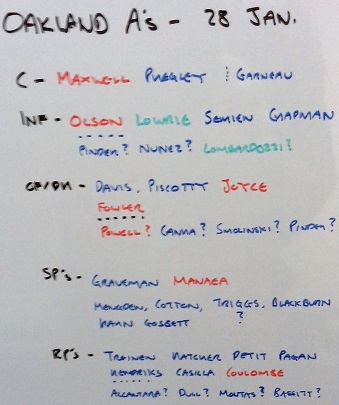
I take a certain amount of responsiblity for this as on the previous Sunday evening I updated my whiteboard to look at the A’s roster options (apologies for the blurry pic).

On the pitching side, the solitary red-coloured lefty Daniel Coulombe stood out, as did the raft of potential starting pitcher options. I almost put Jesse Hahn down as a potential relief pitcher option too as that was being mentioned in some quarters due to his injury struggles and inconsistency.

Well, Hahn now is off the roster having been traded to the Kansas City Royals to acquire lefty Ryan Buchter and to bring back Brandon Moss.

As mentioned elsewhere, currently there isn’t an obvious spot on the roster for Moss unless Matt Olson gets injured (please, no) or Khris Davis returns to left field rather than the original plan of stationing him as the regular DH (wouldn’t quite go so far as ‘please, no’ on that, but he’s no great shakes in the outfield).

Moss will always be a fan favourite from his role on the 2012-2014 teams and his 22 home runs in 362 at-bats with the Royals in 2017 shows that there is still power in his bat.  He could be of use to someone, but at the moment it’s probably wise to see this as a short-term reunion and expect he’ll not be on the A’s roster when they finish Spring Training.

The addition of Buchter is interesting because it plays into a recent trend of the A’s going after pitchers with higher-than-average flyball rates. Looking at his entry in the Ron Shandler 2018 Baseball Forecaster, they reference his “sky high FB%”, 54% of balls hit off him fall into that category, and his tendency to give up free passes. Still, they also note he continued his tendency to get a lot of infield flyballs and there’s definitely something there to work with.

Coulombe was called on more than any other pitcher out of the A’s bullpen in 2017 as he was the only southpaw to call on once Sean Doolittle was traded to Washington. The A’s will be able to option Coulombe to the Minors in 2018 so, injuries dependent, I’d guess Buchter will be the primary lefty and Coulombe will shuttle between Oakland and Nashville,

Buchter joins Yusmeiro Petit and Emilio Pagan as new faces in the reliever ranks and when you include 2017 mid-season recruits Blake Treinen and Chris Hatcher to the list it will be a largely revamped group for 2018.

It’s a group I’m quite optimistic about too.  We all know that a lot will depend on how the gaggle of starting pitchers come together – or not – yet we’ve at least got the potential that if the starters can keep us in more games than not through five or six innings, the bullpen has a decent chance to take care of the rest on most nights.

Weekly Hit Ground Ball: Free Agency Fall-Out

The story of the week has been that, once again, there hasn’t been much in the way of stories to tell.

However, that’s created a story in itself.

Or something like that.

Player and agent angst growing

The slow-moving MLB free agent market has prompted much comment over the past two months and it’s only escalated as each week has gone by with many free agents still not finding a contract to their liking.

The teams will say that they are making offers and it’s not their fault if the players are holding out and waiting for something better.  In other words, the reason free agents are still out there is because players are deciding not to sign contracts on offer.

There’s a certain amount of validity to that position. One of the rumours this week has been that first baseman Eric Hosmer is seeking a deal of eight years or more.  As a relatively young free agent (he turned 28 in October) coming off the best season of his career to date, you can understand him setting his sights high.  However, you can equally understand why teams are reluctant to make such a lengthy commitment in any player, especially one whose performance levels have been inconsistent year-to-year.

MLB Trade Rumors predicted that Hosmer would sign a 6-year, $132m contract in their Top 50 Free Agent round-up back in early November.  There have been rumours of seven-year offers from the San Diego Padres ($140m) and Kansas City Royals ($147m) that subsequently have been denied in terms of the values being thrown about, but there has clearly been interest from several teams and negotiations of lengthy and lucrative deals.

Who is right or wrong in this case is in the eye of the beholder and both sides have strong vested interests in painting the other as the blocker in coming to a deal.

One agent, Brodie Van Wagenen, decided to go on the attack on Friday:

“There is a rising tide among players for radical change. A fight is brewing. And it may begin with one, maybe two, and perhaps 1,200 willing to follow. A boycott of Spring Training may be a starting point, if behavior doesn’t change”.

You’d be forgiven for thinking that an agent demanding teams spend more money on his – and other agencies’ – clients is not exactly a shock; however what can’t be denied is that MLB teams do have plenty of money as they like to tell us this is so.

There’s a sense that MLB wants to have its cake and eat it by on the one hand trumpeting their record revenues ($10bn+ in 2017) and revelling in the high prices the clubs sell for (the basket-case that is the Miami Marlins selling for $1.2bn, for example), but then in the next breath pleading poverty and that teams are losing money.

Something doesn’t seem to add up there, although it may be accurate.  The Premier League is a prime example of how normal rules don’t tend to apply to sports teams as the teams enjoy huge revenues and yet consistently lose money.  The reason usually is because of an unsustainable wages-to-revenue ratio so in the case of football some would say the balance is too far the other way, with too much of the money going into the pockets of players and agents.

The difference, of course, is that Premier League teams have to spend money whatever their ambitions are as not doing so and missing out on Champions League money, or getting relegated altogether, has significant consequences.

The heart of the matter in MLB is that teams not only face no penalties for not spending money, but in fact often are incentivised to ‘tank’.

Another view

That leads onto comments made by the A’s Brandon Moss in an interview on Wednesday.

Whilst acknowledging the issues, Moss put forward the persuasive argument that the situation players find themselves in this winter is in part their own fault as all of the aspects that affect the free agency market are collectively bargained for.

The Players Association (union) has faced some criticism for the Collective Bargaining Agreement reached in the 2016/17 off-season, but the leadership of a union is ultimately beholden to its members.  Moss’s thoughtful comments (and it’s well worth watching the full video linked to above) suggest something I’ve thought for a while: that when push comes to shove most players are happy with their lot and it’s only when things really stir up that they’re prepared to do anything about it.

That’s their choice, but you do get the sense that more players are now starting to ask questions and that the next round of Collective Bargaining talks (the current one will run out aft the 2021 season) will be much more fraught than we’ve seen for many years.

Just a thought …

Thinking about the Premier League example a bit more, the other major factor affecting the market in football is that the top English league is competing against other leagues to sign the best players.  Wages keep increasing because footballers can ply their trade in many countries, whether traditional major leagues in Europe or heading off to places like China.

The overriding issue with the players’ position in MLB seems to be that players often have a very short-term view and in particular to benefit current established Major League players. Moss made that very point, noting his career may not have long to run and his concern is for future players.  We’ve seen in previous CBA negotiations how Major Leaguers have been happy to trade away rights for amateur players (courtesy of significant restrictions on U.S. amateur draft bonuses and international draft pool funds) to win other rights for themselves.

Whenever something comes along to promote baseball more widely (World Baseball Classic, playing series in other countries) there’s always a fair amount of resistance (not from all players, it should be said).

This is very much playing the long game, but if there were more leagues to go and play in then that would only benefit the players.  Of course, the best players will always want to be in MLB and will get paid to do so, but it could create a better market for back-of-rotation starters and ‘average’ position players who would have alternative offers they could pursue.

We’ve seen some players taking that route already, often with the aim of rebuilding their value and then coming back to MLB.  Eric Thames is the classic recent example as he played in Korea for three years before signing a 3-year, $16m contract with Milwaukee over the last off-season.

This off-season, whilst Shohei Ohtani understandably gained all of the attention in joining MLB from Japan, Miles Mikolas has also made the same move.  Mikolas made 37 pitching appearances combined for the Padres and Rangers between 2012 and 2014 before trying his luck in Japan by signing for the Yomiuri Giants.  After three seasons in the Nippon Professional Baseball League, back in December Mikolas signed a two-year, $15.5m deal with the St Louis Cardinals.

So, some opportunities are out there already, but MLB players might want to look to the future when it comes to anything they could do to help promote the game outside of the States.  Putting all of your hopes into 30 MLB owners who basically having a monopoly on the market is far from ideal.

Especially, whether in collusion or not, those owners decide they don’t want to pay you what you think you’re worth.

Weekly Hit Ground Ball: Brewers, Hoffman and more

January is almost over and whilst wishing away months isn’t the best approach to life, it’s understandable with the first of the year.

It normally throws up bad weather and travel problems as well as keeping you in the gloom of days beginning with going to work in the dark and then coming home in the dark too.

But most of all it doesn’t offer much baseball, other than some glimmers of light from places like Australia.

Once we cross over into February we’ll be in the month that MLB.TV prices are announced, teams start reporting back to their Spring Training camps and this year even will be the first month when teams start playing their Grapefruit/Cactus League schedules.

So long January, there’s baseball to be getting on with.

Milwaukee making moves

If you had the Milwaukee Brewers down as the team to get the Hot Stove bubbling again you were looking pretty smart on Thursday.

The Brewers not only revamped their outfield by signing Christian Yelich and Lorenzo Cain, they made the NL Central and Wild Card race a considerably more exciting prospect.

Milwaukee surprisingly spent 60 days at the top of the NL Central last season before the Cubs predictably nudged past at the end of July.  Their second-placed finish ahead of the St Louis Cardinals paled against the similarly surprising Minnesota Twins winning an AL Wild Card at first glance, yet the Brewers finished a win ahead of the Twins (86 to 85) and fell victim to a higher level of competition for the second NL Wild Card than was needed in the AL last year.

The lengthy loss of starting pitcher Jimmy Nelson to a shoulder injury put a dampener on the end of the Brewers’ 2017 and initially affected their hopes for 2018, but the team haven’t let that hold them back.

It’s always great to see a smaller market team such as the Brewers coming out of a building phase with some quality young players and then having a go for it. The excitement of their 2008 season when they traded for CC Sabathia mid-season and just fell short in the NLDS to eventual World Series champs the Philadelphia Phillies is still fresh in the memory – so much so that it was a bit of a shock to find it was a full ten years ago when looking up the details.

They pulled off another big trade in December 2010 when they acquired Zack Greinke from the Royals and then made it to the NLCS in 2011, losing 4-2 to the Cardinals.  Lorenzo Cain was one of the players the Brewers traded away in that deal, which makes his return as a free agent all the more special. Milwaukee didn’t do badly out of that trade by any stretch of the imagination, yet their fans still would have watched Cain – as well as Alcides Escobar – win a World Series with the Royals and think of what might have been.

The same may happen with Lewis Brinson, the talented young outfielder who highlighted the package they sent to the Miami Marlins for Yelich.  However, largely gone are the days when you could swing a lopsided trade for a quality Major Leaguer like Yelich.  If you want to get someone good, you have to give up a good package to do it.

The Brewers judge that they have a shot at the NL Wild Card over the next few years and are doing exactly the right thing by making a group of deals – another one or two may well be forthcoming giving their outfield logjam – rather than just making one addition and stopping there.  There’s no guarantee it will work, but it’s increasingly feeling like some Front Offices are using the lack of any guarantees – and therefore the potential for fingers to be pointed in their direction at a trade or free agent signing going wrong – as a reason to merely tinker around the edges.

You can’t get relegated in MLB so the worst that can happen is things don’t pan out, you trade some players a couple of years down the line and build again.  I love what the Brewers are doing and will continue to hold that view regardless of whether it works out for them over the next few seasons.

Hall of Fame results

Although Trevor Hoffman ended his MLB career with a two-year stop in Milwaukee, everything thinks of him as a San Diego Padre.  Few in North America would link him to Great Britain either, but we had a personal reason to cheer his election to America’s National Baseball Hall of Fame this week alongside Chipper Jones, Jim Thome and Vladimir Guerrero.

Hoffman was part of the 2016 Great Britain World Baseball Classic coaching staff and you won’t find anyone involved in the national programme saying anything other than great things about his contributions.

I started watching baseball in 1998, so I have a strong connection to the excellent Padres team of that year – Tony Gwynn, Greg Vaughn, Ken Caminiti, Kevin Brown, Andy Ashby etc – that was so ruthlessly swept aside in the World Series by a New York Yankees team that ranks as one of the greatest of all time.

Hoffman only pitched in one game during the Fall Classic, taking the loss in Game Three, and that gets to the heart of the hardcore stattos being unimpressed by his election to Cooperstown. Hoffman was a closer who racked up huge numbers of saves, a role and a statistic that many analysts put little store in nowadays when evaluating performance.

I understand the argument, yet it doesn’t take into account the important point that the Hall of Fame is not simply determined by who were statistically the greatest players, otherwise there would be no point in deciding election by a vote.  It is there to recognise historic and memorable contributions to the game.  During the era in which he played, I always saw Hoffman and Mariano Rivera – who few would argue against being a first-ballot election next year – as consistently being the two leading lights in their role as closer.

To say saves didn’t matter, and that Hoffman being the first ever player to reach 500 then 600 count for nothing, has an analytical validity but doesn’t reflect how the vast majority of baseball fans enjoyed his career at the time.  It’s a personal choice for someone to disregard that, yet it’s also a personal choice to decide to take that into account.

Hoffman always stood out to me in part because any appearance or reference to him always led to Baseball on 5 presenter Jonny Gould mentioning that the pitcher’s mother was British. We don’t have all that many links to Major Leaguers, so that always made him a player to watch out for even if he wasn’t on your own team.

Now we can say we have a direct GB link to Cooperstown. I wonder if there will be a Union Flag or two at the ceremony this summer?

The Gouldfish Hall of Fame show?

Given the ever-present Chipper Jones figure that Braves-fan Gould ensured was always on the Baseball on 5 desk, the Hall of Fame announcement sparked the first time this year, and far from the last, that I thought of their MLB coverage with a smile.

Maybe Josh Chetwynd and Dave Lengel can convince their old pal to do a special one-off podcast for the Cooperstown weekend?!

GB pitcher signs with the Cubs

Further on the Great Britain theme, Michael Roth – member of the Great Britain 2012 and 2016 World Baseball Classic teams and the 2014 European Championships – has signed a Minor League deal with the Chicago Cubs.

The former College World Series hero for South Carolina has never quite kept hold of a Major League job in short Big League spells with the Angels and Rangers.  He pitched in Triple-A last year for the Sacramento River Cats (Giants) and Durham Bulls (Rays) and likely will be stationed at that level with the Iowa Cubs this season.

Roth qualifies for the GB squad by virtue of his mother being British. His GB stats can be found in the Project Cobb archive.

Hardball Times Annual -free to download

I had been searching for news on the 2018 Hardball Times Annual for a while, not finding either the new edition available anywhere on the usual book websites or anything on Fangraphs/Hardball Times to say the annual has ceased to be.

It turns out that the Annual is still alive and well but is now being released digitally.  And for completely free!

I’ve reviewed the 2010 and 2011 editions in the past – I think I stopped reviewing them just because they are always great so wasn’t much more to say – and a quick check of my baseball book shelves shows that I’ve been buying it consistently since 2006.  You really can’t beat it for a strong collection of baseball writing, from reviewing the previous season to research articles, history and – new for this year – a baseball fiction section.

Honestly, I always prefer a physical book but if this is the best way to keep the annual going then that’s fine with me. It’s well worth downloading and diving into during February.

Weekly Hit Ground Ball: Unhappy Pirates fans, Unhappy players, Happy MLBTV fans

We’re another week closer to pitchers and catchers reporting to Spring Training camp and, other than a few minor deals, we still haven’t seen much movement on the free agent market.

The continued deadlock is prompting plenty of discussion.  One comment included in a recent Jon Heyman article (attributed to a “player-linked person”, a phrase that tickles me more than it should) made me think more than most:

“MLB has done a good job convincing fan bases not to demand winning … Fans used to only care about winning. Now they say, “Is (the player/deal) worth it?”.

The juxtaposition of that sentiment with the fevered nature of the football January transfer window is striking.  Football fans always want their club to spend money (“if we could just sign one more striker …”) and normally only object to a rumoured deal if they think they should be buying someone better instead (i.e. someone costing more money).

We have to set that in the context of a pyramid league structure in which the threat of relegation means every team has a reason to spend – stoking the market as a result – but the potential for relegation also creates a risk of financial devastation (Portsmouth FC would be a good example for any Americans not familiar with such tales).

Such a risk doesn’t exist in MLB.

Every team has a budget and a bad decision or two on a free agent contract can hamper efforts to build and/or maintain a competitive roster for smaller market teams. No fan wants to see their team chucking money away on bad players. However, I’m beginning to wonder if some fans are increasingly more interested in how their team stacks up in the immediate analysis awards (praised for a good free agent deal, hammered for prospect package given up in a trade etc) than what the transaction will could their team regardless of the cost to the owners.

In 2018 the small market Tampa Bay Rays can afford to give San Francisco $14.5m to go towards Evan Longoria’s salary when they trade him away. Every MLB team is worth hundreds of millions of dollars and every MLB owner or ownership group has huge financial resources, more than enough to cover a bad free agent contract for a few years whilst still maintaining a competitive payroll.

This is no criticism of the data-led, evidence-based conversations on transactions, but maybe there is an argument that rather than creating greater scrutiny on team spending, it’s actually giving front offices and owners an excuse not to take chances and keeping money out of the pockets of players (who ultimately are the ones generating the record levels of revenue) and keeping it in the pockets of the owners.

Pirates fans want owner to walk the plank

You can pour over advanced statistical metrics, consider future payroll commitments and analyse potential success cycles in your division all you want; whatever the facts are, for fans none of them ease the feeling in their stomach – and their heart – when they see one of their heroes sat in a press conference wearing another team’s cap for the first time.

Pittsburgh Pirates fans knew that the day was going to come when Andrew McCutchen would be suiting up for another team, yet that hasn’t made it any easier. Coming hot on the heels of Gerrit Cole being traded to the Houston Astros, McCutchen’s departure to the San Francisco Giants has landed Pittsburgh in a depression broken only by anger.

Fans can accept players leaving, but what has come out this week is the bottled-up frustration of those that feel the club’s owner Bob Nutting refused to open the purse strings between 2013 and 2015 when the team made three consecutive play-off appearances.

The team had been in the bottom four of MLB payroll for all of the nine years prior to 2013 when they rocketed up to 25th of 30, followed by 27th in 2014 (no better way to celebrate your first play-off appearance in 21 years than by reducing your competitiveness) and then the heady heights of 24th in 2015 (where they’ve stayed in the two years since).

ESPN’s Buster Olney among others has made the fair point that just a few results could have changed everything: the NLDS Game 5 decider in 2013 and then the two Wild Card game defeats that followed.  Spending money to add another player or two would have not guaranteed anything either; however nothing’s worse than feeling that your team got close and then didn’t really try to give itself the best chance of going all the way.

A petition has been started that calls for MLB to force Nutting to sell the team, but sadly that request exposes the reality of the situation.  MLB ultimately is the 30 ownership groups and unless you’re really bringing embarrassment on the game – such as ex-Dodgers owner Frank McCourt – such local angst is of no concern to them.

So long as most owners don’t do anything so rash as spend their own money to try to win – the late Mike Ilitch let that cat out of the bag more than once – they can all sit back as their assets grow in value year on year and then laugh their way to the bank when they cash in.

Pace of play

It was inevitable that further pace-of-play changes would be implemented in MLB for the 2018 season, yet it’s increasingly looking likely that they will be imposed on the players rather than as part of an agreed approach.

The most important point with it all is that those of us that regular watch baseball are not the issue here. The reason Rob Manfred wants to force these changes through is his oft-touted research that pace of play puts off casual sports fans (in the US).  In that context it seems as much about being seen to do something (‘we’ve done x,y,z to speed up the games, come and watch …’) than lopping significant time off the average game length.

I can’t say I’m greatly convinced these changes will make millions more tune into a ballgame, nor do I really see pace of play as a huge problem, but I don’t see any harm in cutting down some of the wasted time where possible.  My main issue is the hitters and pitchers that blatantly take the proverbial when it comes to getting on with their job. Effectively penalising the worst offenders, rather than implementing a blanket pitch clock, would be a better approach in my book.

I thought I’d have a look at that by doing a quick bit of rough research to look at the state of play in 2017. I used FanGraphs’ Pace statistic which is a measure of the seconds between pitches for both hitters and pitchers based on PITCHf/x timestamps, so the numbers come with the caveat that they aren’t recorded in exactly the way the proposed 20-second pitch clock would start from.

For hitters, using 100 plate appearances as the minimum criteria produced a list of 435 hitters.  The Phillies’ Cesar Hernandez and the Mets’ Amed Rosario were quickest at 20.7/20.8 seconds, with the Astros’ Marwin Gonzalez the slowest at 29.3 (not that you needed the stats to suspect he was slowest if you’ve ever watched any of his plate appearances). The median average pace number for the 435 batters was 23.6 seconds. As that’s 3 seconds above the quickest pace number, I’ve used 23.6 + 3 as a cut-off point to see how many (and who) were beyond that, what we might call an acceptable level.

26.6 seconds and above produces a list of 26 hitters (6% of the total hitters in the sample).

Player Team Pace
Marwin Gonzalez Astros 29.3
Daniel Nava Phillies 29
Odubel Herrera Phillies 28.8
Logan Morrison Rays 28.3
Jorge Alfaro Phillies 28.2
Robinson Cano Mariners 28.2
Victor Martinez Tigers 28.1
Mark Canha Athletics 28
Hanley Ramirez Red Sox 27.9
Danny Espinosa (Multiple) 27.9
Kole Calhoun Angels 27.6
Nick Castellanos Tigers 27.5
Mitch Moreland Red Sox 27.5
Alex Avila (Multiple) 27.4
Gerardo Parra Rockies 27.3
Kurt Suzuki Braves 27.2
Corey Dickerson Rays 27.1
Bryce Harper Nationals 27
Avisail Garcia White Sox 27
A.J. Pollock Diamondbacks 26.9
Jett Bandy Brewers 26.9
Ryan Braun Brewers 26.7
Christian Vazquez Red Sox 26.7
Gary Sanchez Yankees 26.6
Evan Gattis Astros 26.6
Martin Maldonado Angels 26.6

Unsurprisingly there are quite a few catchers on this list.

For pitchers I used 30 innings pitched as the minimum criteria, which produced a list of 462 pitchers. The quickest from that group was Milwaukee’s Brent Suter (17.4 seconds) and the slowest was the LA Dodgers’ Pedro Baez (30.7).  So, there’s a bigger difference in pace among pitchers than among hitters, with the pitcher median average being 23.9 (those at the figure included Jake Arrieta and Clayton Kershaw).

When you look at the slowest pitchers one finding sticks out like a sore thumb (Rob Manfred would tell you a sore thumb caused by changing channel on the TV remote control).  Among the top 76 slowest pitchers, going down to an average of 26.3 seconds, only 7 were either predominantly starting pitchers or, in the case of Joe Biagini, made a decent number of starts.

Name Team Pace G GS
Matt Garza Brewers 27.9 24 22
Matt Andriese Rays 27.8 18 17
Sonny Gray (Multiple) 27.6 27 27
David Price Red Sox 27.1 16 11
Matt Shoemaker Angels 26.7 14 14
Vince Velasquez Phillies 26.3 15 15
Joe Biagini Blue Jays 26.3 44 18

And, yes, just as there were no surprises that Marwin Gonzalez was on the hitters’ list, David Price was a shoo-in to be on the pitchers’ one.

What you see though is that a lot of slower pitchers are relievers.  That’s no great revelation as relievers, due to the way they are used, are more likely to be deliberate with every pitch they throw; however it shows how pace of play can be affected by lots of things.  The increasing use of relievers for strategic purposes is likely but one part of that, due not only to the time taken for pitching changes and mound visits but also the more deliberate style of pitching.

Looking ahead to 2018 MLB.TV

Pace of play isn’t going to influence whether any of us are signing up for MLB.TV this year.

One of the landmark ‘baseball is coming’ moments for many of us every year is the day on which the MLB.TV subscription details are released.  MLB.com announced the packages and prices on 7 February last year, so we should expect to see the details in the next two to three weeks.

The 2017 main MLB.TV annual subscription cost $113.  We have to pay 20% VAT on top (which made it $135.59) and then factor in the dollar/pound exchange rate, so last February/March that worked out at approximately £108.  Things have turned in our favour over the past year on the dollar/pound front (as opposed to previous years of it going against us) and that same $135.59 would work out at at approximately £100, so a bit of a saving.

As part of settling a US lawsuit about TV subscriptions and blackouts in 2015/16, MLB had to agree to only increase their online subscription packages by 3% or the rate of inflation (whichever is higher, currently would be the 3%) year-on-year until 2020.

If we add 3% to the 2017 price ($113 plus $3.39, so let’s call it a US price of $116), include the VAT and take the current dollar/pound exchange rate into account then that would make for a UK cost of £102.  The team-specific subscription would be approximately £79.

We’ll have to wait for the official announcement to see quite what packages they will be selling and the price, so treat those as an educated guess for now; however, in theory the US prices should only go up a small amount and – due to the dollar/pound exchange rate – should actually work out a bit cheaper for us than a year ago.

Weekly Hit Ground Ball: Is the Hot Stove about to heat up?

Compared to the weeks before it, the last seven days have been relatively busy in MLB.

None of the biggest names on the free agent market have found a new club, but there have been some free agent signings plus the deadline for salary arbitration submissions on Friday has created more certainty over payroll commitments and may well help to push the free agent and trade market on next week.

We can but hope.

Bruce to the Mets, Reed to the Twins

Two free agents came off the market with outfielder Jay Bruce reuniting with the New York Mets (after a couple of months with Cleveland) and the news on Saturday that reliever Addison Reed has agreed a deal with the Minnesota Twins.

Bruce signed a three-year, $39m contract and is the type of player who isn’t going to have people doing cartwheels on finding that their team has signed, yet is a decent experienced Major Leaguer and it turns out was available at a relatively reasonable price.

Bruce in the past has been a player who could get you some home runs but didn’t offer a huge amount of value otherwise. However, he had a good season last year combined with the Mets and Cleveland in what was his best year since 2013 with Cincinnati.  Although you may try to chalk that up to it being his ‘walk year’, FanGraphs notes that Bruce did display a new approach at the plate in 2017 and so the hope is he has made an adjustment that will continue to produce results.

The Mets are an interesting team to ponder for 2018.  Last year was nothing short of a disaster and there are so many fitness question marks over their pitching staff that it’s easy to just write them off.  You look at their roster though and you can put forward an argument that a Wild Card run might not be completely out of the question, albeit requiring a fairly long list of ‘ifs’ to work out in the Mets’ favour.

The Minnesota Twins are also a team that many seem to be overlooking.  They took everyone by surprise last season by winning an AL Wild Card in what turned out to be a somewhat weak race and so it’s understandable that there is doubt over whether they can back that up in 2018.

That shouldn’t obscure the fact that they’ve got some real talent on their roster though and Reed will certainly add to that list.  Rumours continue to swirl that the Twins are determined to add a quality free agent starter too this off-season and whilst I’d guess they will fall short in their pursuit for Yu Darvish, Lance Lynn or Alex Cobb could well fall into their price range and slot in very nicely alongside Ervin Santana and Jose Berrios.

Gerrit Cole

The Gerrit Cole trade story so far essentially goes like this:

  • He was on the verge of being traded to the Houston Astros
  • Then he wasn’t
  • He still might be
  • But he hasn’t gone anywhere yet
  • Although Buccos fans are expecting they’ve seen the last of him in their uniform

The Astros are in the best possible situation with a World Series win behind them, a talented roster in place and a strong farm system of Minor League prospects to deal from if they wish.  Whilst you could justifiably argue they don’t need much in the way of additions, other than an upgrade in the bullpen perhaps, that’s a very strong position in which to trade from.

[LATE EDIT: Cole is now an Astro!]

Arbitration explained

Friday was the deadline for salary arbitration numbers to be submitted and this prompted one reader query around quite how the MLB contract process works.  That’s one of many topics I cover in my Baseball Basics for Brits series, which I’ll be updating over the next two months. Here’s a basic guide to the MLB contract situation and how arbitration fits in.

When a player begins his MLB career he is under contract for six years, at the end of which he becomes a free agent unless he has negotiated a contract extension prior to this.

For the majority of players, during the first three years of their initial MLB contract they receive the MLB defined minimum salary.  This typically increases slightly every year. In 2018 the MLB minimum salary will be $545k (just under £400k). A team is able to pay more if they wish. If they do it tends to be by a small amount – no one wants to pay more than they have to – although slightly larger raises can be paid occasionally if the player is exceptional.  The team may still only pay them a little bit more in that situation – $100k, say – but it’s more a matter of principle than the money itself.

For years 4 to 6 the player becomes ‘arbitration eligible’.  The player is under contract with the team regardless (unless they release him) but how much they will be paid is negotiated year-to-year (again, unless the team and player agree a multi-year deal instead).

The arbitration element kicks in where the two parties can’t come to an agreement.  There is a hard deadline at which both parties must submit the figure they want – this past Friday in this year’s case – and then an independent arbitration hearing will be scheduled.  Negotiations can continue right up until the hearing and in the majority of cases the two parties will come to an agreement.

However, if they still can’t agree then the hearing takes place with both sides arguing in detail why their submitted figure is appropriate.  The main reason why parties like to avoid this situation is that ultimately it results in the team having to explain why the player isn’t as valuable as he thinks he is, which is not a particularly comfortable situation. The arbitration panel will listen to the submissions and then make a decision on which of the two figures is fair.  They can’t just split the difference or suggest something else, either the player ‘wins’ or the team does.

An important part of this process is that there is an underlying principle that a player deserves to be paid more as he gains more service time in the Majors. In other words, if a player had a downturn in performance in his fourth year, he would still get a salary raise for his fifth year, albeit not so much as he would have done had he performed better.

What this means is that salary arbitration negotiations aren’t just about the coming season, but also about future arbitration seasons as – if it ultimately goes to the arbitration panel – the main consideration will be how big a raise from his previous salary that the player deserves.

For example: Team A wants to pay Player X £5m in his fourth year, Player X wants $7m. If Team A ‘wins’ and the player still performs well then the fifth year salary might be $7.5m and the sixth year salary $9.5m.  If the player won then his salaries might go $7m, $9m and $11.5m.  So the initial case wasn’t simply about a difference of $2m but actually a difference of $5.5m.

There are some additional variations on this process, the main one of which to be aware of is that the very best players (as defined by specific criteria set out in the Collective Bargaining Agreement) become arbitration eligible a year early.  These players are known as ‘Super 2’ players.

An elephant never forgets, and neither does agent Scott Boras

One such Super 2 is the Chicago Cubs’ Kris Bryant. Jon Heyman tweeted a message about Kris Bryant and the Cubs coming to an agreement on a one-year deal on Friday to avoid an arbitration hearing and stated that the team would like to do a multi-year deal with the player.

I’m sure they would, just as they would like to do a deal with him down the line to keep him as a Cub for years to come rather than lose him to free agency when that time potentially comes.

However, the latter point is firmly at the front of Bryant’s, and particularly his agent Scott Boras’s, mind.

Let’s not forget, the Cubs royally screwed Bryant over at the start of the 2015 season.  They deliberately delayed his debut for a couple of weeks solely so that he would be unable to accrue a full year of Major League service time in 2015 and his post-six year free agency would therefore be delayed by a whole season.

It would be fair to say that it’s the rules that are really at fault there – given that those are the rules, it was a logical business decision for the Cubs to make – but the Cubs still knew what the longer term impact on the player would be when they made that choice.

Bryant’s deal of $10.85m is a record for a first-time arbitration eligible player and you have to think that there is an acceptance on the part of the Cubs that they have to give a bit of ground in the circumstances.

Game times released

Fans could start doing a bit more planning for the regular season from Wednesday as MLB updated their regular season schedule by adding in game times.

They take on added importance to us based on the convenience of watching live games with earlier start times.  The details are subject to change, so you shouldn’t get too tied to first pitch times too far ahead, but we should be able to rely on the current start times for the opening series being accurate.

As already known, Opening Day on Thursday 29 March is going to be a baseball feast with the first game – Chicago Cubs at Miami – from 12.40 Eastern Time (17.40 our time) and the final two games – Cleveland at Seattle and Colorado at Arizona – getting going at 10.10pm ET (03.10 am for us).

Fans of 24 teams will be able to catch their opener at a convenient British evening time.  The San Francisco and LA Dodgers are the other two starting at night US time (7.08 ET, 00.08 am for us) making it six teams for whom their UK fans will need to be up in the early hours to see their season opener live. That shouldn’t be too much of a hardship though, especially as it’s Good Friday the following day.

If one of those final two games goes 3.5 hours we’d be looking at 13 solid hours of baseball by which to welcome MLB back.

Sounds good to me!