Category Archives: Project COBB

News and information relating to the Project for the Chronicling of British Baseball

The Dewar Trophy: Further evidence for British baseball’s grand beginnings

I was generously sent a copy of the photo below by Dick Miller. Reading off the original, Dick could make out the words “Dewar Trophy” in the inscription, which almost certainly places the item as being from the 1890s. According to an article by James Wilson entitled “Baseball in England, and its rivals” that was published in The Strand Magazine in 1898:

The greatest supporters of the game in England [include] American business firms, such as the Messrs. Fuller, the great confectioners; Messrs. Dewar, of whisky fame;  [and] J. Earle of the Remington Typewriter Co. […]  These gentleman assist the game, both in a monetary sense and by personally attending the games and bringing their friends.”

The trophy is presumably one of the examples of the Dewar company assisting the game in a monetary sense.

In addition, all three business entered teams in the London Association competition of the mid-1890s. In fact, Dewars and Remingtons were involved in one of the early classic tussles of British baseball, a 12-inning belter of a contest at the Crystal Palace on 20 August 1895. The ebb and flow is evident from the linescore.

Remingtons…. 3 6 0 0 4 0 0 2 2 1 1 2 — 21
Dewars……….. 0 2 1 5 0 1 1 3 4 1 1 1 — 20

The Dewar Trophy was not unique in this early part of British baseball history. Other benefactors during the first wave of sustained domestic competition included Albert Goodwill Spalding and British Baseball Hall of Famer Sir Francis Ley, and both of these men are known to have donated trophies of similar splendour to commemorate champions.


Hammer-Smith duo shine torch on Cobham Yankees

Alan Smith has been one of the most significant Project COBB collaborators since its inception back in October 2008. As just one example of this, the backbone of the modern top-tier stats archive comes from his determined and successful efforts to piece together the statistical history of the London Warriors, aided by other ex-Warriors such as Brad Thompson.

His latest major contribution resulted from linking in Cobham Yankees stalwart Pete Hammer with the research and archiving initiative. Hammer was sitting on a digital gold mine, and he managed to string together 61 attachments in one of the most remarkable, and largest, emails I’ve ever received. Most relate to the Yankees, but some contain information on the Oxshott Orioles, a feeder team for the southern baseball giants.

Many of the materials are safely stored for now in the offline holdings, and, as with all of these materials, anyone is welcome to request a search of these.

The materials that have been immediately taken into account in the online archives all relate to the 1983 national final, which Project COBB previously lacked much in the way of information on. Now, thanks to Pete and Alan, we have a team photo from a neighbouring year, the championship programme, and the pitching line of the winning hurler.

The Cobham Yankees of 1982


George Price continues to unearth baseball treasures

George Price, an octogenarian from the north-west corner of England, is one of the generous collaborators who make Project COBB function. He has previously proved to be very helpful in supplying team photos and identifying players for uses such as the Great Britain national team archive, and very recently he has uncovered a couple of more textual gems.

The first is a Merseyside Baseball League handbook from 1951. Having this item has given me the inspiration to set up a league handbooks section on the Project COBB site, which I will expand over the coming weeks. These small artefacts are quite easily one of the best resources for historical information on fixtures, competition structures, team personnel, and club details.

The second item is an amazing collection of minutes from general meetings held by the Atoms and the Liverpool Aces between 1957 and 1964. It gives a rare glimpse into the running of an amateur baseball club in Britain during this poorly chronicled period. I have made scans of the photocopies that George sent me, but they’re not of a sufficient quality to put on the site. However, anyone interested in seeing a PDF should contact me here.

I had the pleasure of meeting George earlier this year, since he was welcomed as a guest of honour by Richmond Baseball Club as part of a trip arranged by his son as an 80th birthday present, and I happened to be scoring that today. A couple of the photos taken that day are provided below.

The author (dark top) standing with Project COBB collaborator George Price (light top)

George Price throws out a ceremonial first pitch at Connare Field in a National Baseball League game in 2011 between the Richmond Flames and the Southampton Mustangs

George played baseball in Liverpool during his younger years. His father, Dave Price, was a noted ambassador for Merseyside and British baseball during the 1960s and even raised awareness of the game here over in the States on family visits.

Domestic baseball in Britain at least as early as 1876

NOTE: The same discovery, of domestic baseball in Britain being played 13 years earlier than what was previously thought to be the genesis season, was independently made at almost the same time by David Block, an American baseball historian with more than a passing interest in Britain’s ties with the early game.

To avoid any confusion among readers unfamiliar with the game’s early history, I’m calling it “baseball” here, but really it was still mostly referred to as two words (i.e. “base ball”) back then.

While I was conducting the research for What about the Villa? back in late 2009 and early 2010, one of the topics I was interested to delve into was the question of whether the ramping up of baseball activity in 1889 and 1890 represented the first domestic baseball in Britain. Like other researchers who had looked into this area, I came to the conclusion that this indeed appeared to be the case.

I had carried out my pre-1889 research using online searches of the British Library’s digitized collection of 19th Century newspapers. Shortly after I had moved from the research phase into the writing phase, the collection was supplemented with a batch of 22 additional titles. I didn’t realize this until I very recently went back to carry out some searches on a different topic.

After establishing that the collection I was searching had increased in richness, I decided, on a hunch, to return to the question of early domestic baseball in Britain. Continue reading

An update on Colindale and news of the next Project COBB book

Update on Colindale

Back at the start of July I described the pressing need to get to the British Library’s newspaper repository at Colindale if you are based in the south-eastern corner of the country. This was triggered by an article I’d come across on The Guardian website from 2010 stating that this north London research institution was set to close before the end of 2012, owing to funding becoming available to transfer the holdings to a more modern facility in Yorkshire.

Later in July, another story appeared on the newspaper’s website. In the article, Roy Greenslade described the answers that historian David Kynaston was able to obtain when he posed the following two questions to a senior member of staff from the library: When is Colindale actually going to close? And what will be the state of access to newspapers after it does? (The answers to the questions were originally reported in a feature on the History Today website.)

“The answer to the first question is relatively straightforward: not before July 2013. The proposed state-of-the-art repository at Boston Spa, to house Colindale’s huge collection of hard-copy newspapers, has not yet started to be built; and given the current fiscal context it struck me… that the eventual closure date may turn out to be further away.

As for the second question he was keen to offer reassurance that post-Colindale there will continue to be access to hard copy as long as there are no surrogates readily available, which is the same as the position now.

Those surrogates are two-fold: the existing stock of microfilms (mainly national titles, but not entirely), which will be transferred to St Pancras and be available to be read on microfilm readers there; and digital surrogates…

Because of digitisation the demand for hard copy is already declining and that trend will intensify.”

That is excellent news for readers who can get to London easily, but of the newspapers for which only a hard copy is currently in existence, a good chunk (roughly 30%) are not in sufficient quality to allow transportation from the Yorkshire site to St Pancras. Moreover, for the 70% that might be transported, it’s not yet clear what limits might be set on daily allowances.

It seems that there is still some urgency to get to hard-copy-only materials, but we can ease our foot off the gas slightly where microfilm is concerned.


Next Project COBB book: Nine Aces and a Joker

The Project COBB winter research team is now in place, and the main task we will be tackling is underpinning the next Project COBB book. The book, which has a working title of Nine Aces and a Joker, will chart ten of the most engaging seasons by pitchers in British baseball between 1890 and the present day. The project will bring together contributions from various talented authors (including two of my fellow BaseballGB scribes) on different pitchers in their defining seasons. Fineleaf plans to publish the book in print and digitally late next year.

The first official Research Day for the book will be this Saturday, but I conducted a recce last weekend. This was not only to remind myself of the Colindale procedures, but also to ensure that there was a suitable place to host our post-research discussions. When I informed my fellow researchers of this noble act, one of them returned with the following comment: “I hope you don’t find the pub research too taxing.”

On a more serious note, I thought I might get a bit of a head start on the research for one of the chapters for which the background material was a bit patchy, and I was rewarded with a good omen. I selected a newspaper at random from the five that seemed like they might cover baseball in the particular player’s locality and carefully opened the bound volume somewhere near the middle. Right in front of my nose on the first page I looked at was a report on a game in which my quarry was on the mound. I felt like I’d thrown an inner bull from a 50-foot oche.

Full article: How Hull won the cup in 1937, by Colin Allan

articlesGuest author
Colin Allan

Summary
The author tells the story of how Hull Baseball Club won the National Baseball Association cup competition to be crowned British champions in 1937. The account includes details of all their victories along the path to their historic triumph at the peak of baseball’s popularity in Britain.

Access the PDF
Click here

Please leave comments on the article below.

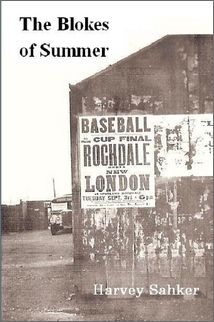
The Blokes of Summer, by Harvey Sahker

Blokes_of_SummerI have the cure: The Blokes of Summer, by Harvey Sahker (published back in April, and available in print or as a PDF download).

The ailment is baseball withdrawal symptoms. For those members of the British baseball community with no great interest in MLB, the symptoms have probably already kicked in. While for the majority who do follow the Big Leagues, the inevitable is just round the corner.

This is not going to be a formal book review, but instead a casual feature. My guess is that Matt Smith will enjoy this book, and he may well wish to apply his far superior reviewing expertise to it. Additionally, his impartial standpoint will be of benefit. If I wrote positive things about the book in a review,  it would too easy for readers to dismiss it as me repaying a favour. Harvey has done some great things for the Croydon Pirates, my former club, including publishing their 30th Anniversary Yearbook, bringing in baseball gear from his native Canada for the team on many occasions, and being a loyal and skilled servant on the diamond. He has also benefited me by supplying numerous pieces of help to Project COBB.

The truth is that the book is, in its own right, fully deserving of any praise I would have bestowed in a formal review, and am about to give in this casual feature. In my view, it makes a formidable addition to the small but growing library of books on British baseball. Continue reading

Vote now in the British Baseball Photography Competition

bbpcThe National Baseball Championships have been played, the nights are drawing in and most players have swapped their cleats and pants for an armchair. But at least one more contest remains to be decided: the 2011 British Baseball Photography Competition.

A panel of judges convened in September to whittle the 145 entries down to 10 finalists. Now it’s time for the judging panel to turn over the shortlisted entries to the British baseball community, so that members can cast their vote on which image they think is the pick of the bunch.

During the rest of October, you will be able to have your say on which photo you think deserves to win via an online ballot. To cast your vote, browse through the 10 shortlisted entries in the specially created gallery, and then once you have decided on your choice, open up the voting window by clicking on the link in the gallery footer.

The ballot will close at 11.59 pm on 31 October, and each individual is limited to one vote.

Gerard-Thesingh, Gladu, and Thurston are latest inductees in the British Baseball Hall of Fame

BBHoF_bgb

The second Tuesday in October, now established as the traditional time for announcing the new annual set of inductees into the British Baseball Hall of Fame (BBHoF), sees three more individuals receive the highest honour in the game:

  • Ted Gerard-Thesingh (Coaches, managers, umpires, and other officials);
  • Roland Gladu (Baseball players);
  • Brian Thurston (Baseball players).

They join the eight individuals already inducted in the first two classes. Biographies for all inductees, and more information about the BBHoF, can be viewed on the official webpage: www.bbhof.org.uk.

The biographies for the inductees in the third class are reproduced below.

Ted Gerard-Thesingh
For more than two decades, Ted Gerard-Thesingh was Great Britain’s top umpire, working 13 national championship contests and more than 100 international matches.

Beyond his role on the field, Gerard-Thesingh also trained countless other umpires and was a dedicated administrative official at various levels of British baseball. Gerard-Thesingh moved to the United Kingdom from South Africa in 1979. Upon learning there was a dearth of umpires in British baseball he set to work recruiting and then teaching new officials.

Quickly garnering respect for his work behind the plate and on the bases, Gerard-Thesingh earned assignments in all but one national title games between 1982 and 1995. Internationally, he was also an umpiring fixture. He officiated in the 1984 and 1988 European Championship B-Pool and the 1989 European Championship A-Pool in Paris, France. A serious injury in the mid-1990s cut his umpiring career short, but Gerard-Thesingh continued to contribute to British baseball.

He served as technical commissioner at a number of national finals and at the 1996 European Championship B-Pool in Hull, England. In recognition of his many years of service, Gerard-Thesingh was made an honorary life member of both the British Baseball Federation and the Amateur Baseball Umpires Association–Great Britain (ABUA-GB). In addition, the ABUA-GB began bestowing the “Ted Gerard-Thesingh Trophy” in 2003 as an annual award to acknowledge outstanding effort by a particular umpire each year. Gerard-Thesingh also received a Lifetime Achievement Award at the 2006 national finals.

Roland Gladu
Described in the 1939 book Baseball for British Youth as “[p]erhaps the finest batter who has ever played for an English team,” Roland Gladu was the only 20th Century positional player known have to competed in a domestic Great Britain circuit and then risen all the way to the Major Leagues in the United States.

Dubbed “the Babe Ruth of Canada” by the British press during his 2 years in the United Kingdom (1936–37), the French-Canadian Gladu played primarily for West Ham in the effectively professional London Major Baseball League.

As the club’s player–manager, he led the team to top-two finishes in both of his seasons as well as to one remarkable upset: a 5–3 triumph over the 1936 United States Olympic baseball team. In that contest, Gladu connected for two hits, including West Ham’s only extra-base hit (a double). While statistics are incomplete from this era, it is known that he led the London circuit in batting with a .565 average in 1937. Seven years on from his time in Great Britain, Gladu ascended to the Majors, hitting .242 with one home run in 21 games for the 1944 Boston Braves of the National League.

Brian Thurston
Brian Thurston, who retired as Great Britain’s most capped international pitcher, was a dominating force both domestically and abroad.

Thurston appeared in seven European Championships, throwing 83.0 innings and posting a 5–4 record with a 2.82 earned-run average. He also pitched his club side to multiple national honours. The left-handed Thurston led Great Britain to promotion into the top tier of European baseball in 1988, earning the Most Valuable Player award at the European Championship B-Pool on home soil. He won two games at the event, including the final against Czechoslovakia, in which he threw a 7.0-inning shutout, striking out 12 batters. The publication First Base described the outing as “a stirring display of power pitching.” Other stand-out performances were to come.

In 1989, he struck out 25 batters in 23.2 innings at the European Championship A-Pool in France and 2 years later he posted a 3.18 earned-run average, fanning 20 hitters in 17.0 innings at the 1991 championships in Italy. Despite suffering an arm injury later in his career, he also contributed to Britain’s international success with the bat. At the 1996 European Championship B-Pool in England, his run-scoring 10th-inning hit against Lithuania in the semi-finals secured Great Britain’s promotion back into European baseball’s elite group after relegation 5 years earlier.

Equally impressive in British league play, Thurston was a long-time member of his local side, the Hull (Humberside) Mets. During his club career he led the Mets to three national titles, a silver medal at the 1992 European Cup Winners Cup qualification tournament, and three national Knock-out Cup trophies (in the 1992 triumph, he threw a 7.0-inning no-hitter).

Updated schedule for pre-Christmas Project COBB Research Days

PCRDOwing to the availability of researchers, the start of the Project COBB Research Days series has been postponed until Saturday 3 December, but the proposed Saturday 17 December is still in place, and so there will be two pre-Christmas opportunitites to meet up at Colindale, North London. The main aim will be to add another patch or two to the growing quilt of British baseball history.

With two or three BaseballGB writers going to be among the attendees, the days will also offer a chance to retire to a convivial watering hole in the afternoon to discuss British baseball, MLB, or any other hardball-related topics on your mind. With the winter drawing in, the Hot Stove will be on gas mark 6 by this stage.

Full details of the planned Research Days, and the urgency of getting to Colindale during this off-season, can be found in the original article on BaseballGB.

To sign up for either of these dates, please get in touch by leaving a comment (your email address will come through to me) or using the contact form here.