Category Archives: Project COBB

News and information relating to the Project for the Chronicling of British Baseball

One from the Present: Patience

I know my writing focus is normally on the top tier of British baseball, but sometimes the story is so good that a deviation from the norm is justified. Moreover, there was a need to smooth out the British baseball karma, and so after my look at “Frustration” from one game on 29 May, here is a consideration of “Patience” from another on that date. Continue reading

One from the Present: Frustration

If a physicist was to create an equation to predict the chance that a fair fly-ball would hit the top of the perimeter fence and bounce back into play, then factors that would probably feature in the modelling include layout of the field, trajectory of the ball, velocity on leaving the bat, air pressure, and wind speed and direction. She (yes, not all physicists are men) might want, for extra credits or some other perfectly valid reason, to tailor the formula for British baseball, in which case the existence of fencing in the first place would need to be established, as indeed would the material used. Continue reading

Keep the entries coming for the BBPC

The British Baseball Photography Competition (BBPC; run in conjunction with Project COBB Photography) has been showcasing the work of both experienced and novice photographers from the baseball community over the past two years.  The 2012 season sees the third running of the competition, and although it is still early days, it looks like it will be a challenge to top the total of 145 photos submitted in last year’s competition.

But the slow start is quite probably in large part due to the unpleasant weather we’ve endured (and the resulting lack of fixtures) during the opening weeks of the season. Cold, wet conditions do not make sports photographers eager to get their equipment out.

The good news is that with the glorious weather we are now enjoying, there should be games galore and no excuse to leave the camera at home. In addition, the submission process is now slicker than ever as the clever folks at BaseballSoftballUK have built a special online entry form.

The online entry form can be accessed by clicking HERE.

Once we get to October, a shortlist will be drawn up and published for a public vote, and the winner — who will receive £100 in photo vouchers — will be announced in November. For handy hints on how to please the judges, check out this article. Full competition rules can be found by clicking here.

One from the Past: “Balks”

Sports junkies are addicted to oddities, and a regular fix is offered by the abundance of individual incidents played out within North American organized baseball’s daily schedule, not to mention the global game. I count myself among the junkies’ number and, until half an hour ago, took pride in thinking that if there was a potential event that I had not seen with my own eyes, I had at least conceived of its possibility. But that was before I started browsing through some press cuttings for the Cobham Yankees in 1987.

On Sunday 10 May of that year, the Yankees played regional rivals the Sutton Braves in a league contest. The Yankees entered the seventh inning facing a 9-1 deficit but rallied for 8 runs in the frame to draw even. On an initial skim of the cutting I read the following:

The inning featured three base-hits by both Brad Thompson and Alan Smith, Cobham’s catcher and centrefielder.

There was my fix. An incredible occurrence. But then I did my sums and had a rapid come-down. For two players to get three hits in an inning, a minimum of 14 runs would need to score. Cursing the journalist who had been so cruelly inept, I re-read the words. And then I spotted something. My eyes had tricked me by vaulting a hyphen over a four-character gap. What the journalist actually wrote did add up; but, sadly, it was not going to get me my high:

The inning featured three-base hits by both Brad Thompson and Alan Smith, Cobham’s catcher and centrefielder.

Feeling a little ashamed, I meekly read on, but then suddenly realized why my eyes had been so prone to deception. The opening paragraph had promised an “ending so bizarre that nothing like it had been seen in the Southern League in years.” I had just been premature, I thought.

I read on. The Braves were not done yet: they rallied back to take a 12-9 lead into the bottom of the ninth. But the Yankees responded with 3 runs of their own and had runners on first and third with one out.

Was this it? A double comeback? It was probably very exciting to have been a part of, but 25 years on it was just not doing it for me. Again, I cursed the journalist. Again, I had erred.

So what was the bizarre ending then? Well, Cobham had Gene Hickman at bat, and Sutton decided to intentionally walk him, presumably to set up the force at home. As the journalist kindly explained for a readership who would, for the most part, have been unfamiliar with baseball’s finer points: “in order to walk Hickman, the Sutton pitcher had to pitch the ball outside the strike zone four times.”

Well he managed this once, but on the second pitch he “inexplicably halted his motion” and was adjudged to have balked. And this ended the game, as the winning run trotted home from third. A walk-off balk on a failed intentional base on balls attempt. Is there a stranger, or more embarrassing, way to end a game?

The Yankees also got the better of the Braves in the quarter-finals of that year’s national play-offs, on their way to securing a second championship in their record-setting run of three straight titles.

One from the Present: “Losing”

Neither team deserved to lose.

You don’t have to reach too deeply into the bag of diplomatic sports interview responses before you uncover the above gem. A sacred and universal tradition among interviewees dictates that it should be left close to the top of the bag, owing to the frequent need for its retrieval. In football, the unwritten code instructs one to return the phrase by nestling it between “they played a great game” and “they made it difficult for us early doors.”

The question of whether the statement can be substantiated from metaphysical first principles for a zero-sum game with only two possible outcomes,  such as a baseball match,  rarely gets the consideration that it merits. In other words, it’s bullshit — unless the game was in the infinitesimally small pool of contest in which the two teams were exactly even in their performance level.

But how about the phrases “neither moundsman deserved to lose” or “neither twirler deserved to lose”? (Both of them, incidentally, are making their debut on the Internet, or at least the portion of it accessible by the Google search engine. Try / it.) If the duellists both put in solid efforts that would on an average day get them a win, then it makes sense to say that neither deserved to be charged with a loss.

All of the above represents a circuitous way for me to say that I’m not being silly in writing the following:

In the opening game at Northbrooks Playing Fields last Sunday, neither pitcher deserved to lose.

Jamie Ratcliff twirled a shutout as the Harlow Nationals bested the Bracknell Blazers. The 18-year-old Brit gave up his first and only hit of the game when he was just two outs away from a no-hitter. It would be extremely difficult to make a case that he deserved the loss. His opponent, Henry Collins, also went the distance but gave up a run. You would feel irked in the Major Leagues if you gave up a solitary tally and still lost, but in British baseball it is almost unthinkable. A past victim of the “almost unthinkable” was Nic Goetz, whose one run given up in a complete game for Herts against Croydon on 30 May 2010 was one run too many.

In the game last Sunday, Collins — the only British born-and-bred winner of the Most Valuable Pitcher award in the past 10 years — gave up a pair of hits, a walk, and a run in the first inning, but over the next four frames the only damage to his pitching line was a bare single. In the sixth, he gave up a lead-off hit but seconds later erased the blemish with a well-executed pick-off play. Deeper into the inning, he gave up his only extra-base hit, to Edwin Alcanatara. It could be argued that he made a mistake with that pitch, but to the batter in question anything that doesn’t bounce (and even some that do) could potentially end up being branded a “mistake”, such is the unorthodox and ever-thrilling interpretation of the strike-zone by the Dominican gentle giant, last year’s triple-crown winner.

Perhaps I have missed the point. I should not have become involved in lamenting the unjustness — the losing pitcher and his squad-mates were capable of looking after that themselves. Instead, I should have been celebrating this rare scoreline. But I felt like throwing a pitch in the dirt myself, and as a fan of this marvellous sport I am sure you had little trouble in blocking it.

One from the Present; One from the Past — A consolidated, semi-regular column

I can derive great joy from uncovering details of an important but long-forgotten British baseball clash in a newspaper library. The enjoyment has much to do with the respect I have for the history of baseball. This is an appreciation that extends to other sports. As an example of this, I have my cycling computer set to kilometres instead of miles, not to cheer myself up by the greater rate with which the digits tick over, but to pay a small kind of homage to the land of all things metric and so many great two-wheelers, including the late Laurent Fignon. His gruelling battle with — and eventual 8-second loss to — Greg Lemond in the 1989 Tour de France is probably a singularly important factor in the development of my love for sport. (Eight seconds is an infinitesimal amount in the context of a 3-week stage race; if the action was condensed into a 10-second dash, the cyclists would not have been split by the naked eye or by a photograph).

I also get excited by baseball that happens in front of me, in three dimensions, using the full spectrum of colour and the entire range of audible sounds. Only last Sunday, instinct lifted me from my seat (and sent my head on a treacherous journey into the internal spidery mechanism of my ground-rooted fishing umbrella) when the Harlow Nationals’ first baseman Jarrod Pretorius threw himself over the fencing marking the edge of foul territory — his intended domain — and came up with the ball for the out.

If you tried to weigh up these two types of enjoyment using a pair of scales, the measuring aid would vapourise out of the space-time continuum because they are incompatible as far as making comparisons is concerned.

In the same way, I gained orthogonal enjoyment from writing two previous BaseballGB columns, one on current reflections (Roundshaw Hop) and the other featuring historical snippets (the Cobbettes). If, with your replacement set of scales, you tried to make another comparison of enjoyment levels here, you’d again find yourself heading out to the hardware store with your hand in your pocket.

Fortunately, I don’t need to make a choice between the two areas. Project COBB (the Project for the Chronicling of British Baseball) has the dual purpose of preserving details of baseball today and restoring the happenings from yesteryear. And my new semi-regular column on BaseballGB will consolidate the themes of my two previous serials in alternating between the current and the realms of history: One from the Present; One from the Past.

Mobile web browsing British baseball

Anyone who runs a website and has set up an analytics tool will be familiar with the hours that can be wasted poring over detailed reports of site users’ traits and habits. Like many webmasters, I use Google Analytics as my time-wasting tool of choice. From time to time, though, this very sophisticated but free reporting platform can yield a nugget of genuine insight.

Continue reading

Nine Aces and a Joker: Provisional cover design

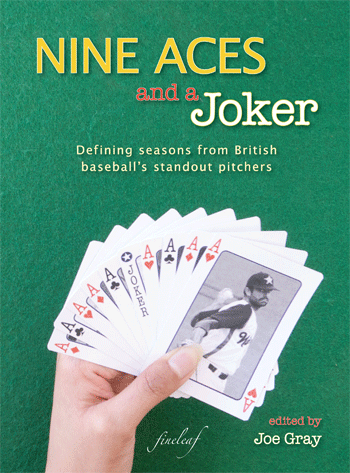
A provisional cover design has been prepared for the forthcoming Fineleaf Editions title Nine Aces and a Joker: Defining seasons from British baseball’s standout pitchers. This will be the second book by Project COBB, with fellow BaseballGB crew members Matt Smith and Mark George among the contributors to this effort. More news will follow soon.

BSUK fills gaps in national champs archive with nine missing artefacts

The previous BaseballGB article in the Project COBB category demonstrated the historical stretch of the British baseball chronicling initiative by reaching back into the 19th Century, but this latest post illustrates the equally strong focus on recording more recent times.

BaseballSoftballUK (BSUK), the agency overseeing baseball’s development in Britain, has been diligent throughout its existence in retaining artefacts from British baseball history, and many of the digitized holdings on the Project COBB website come from the shelves of Ariel House, where the company is based.

The latest batch of materials that BSUK has been kind enough to scan in and supply (thanks go to Tim and Trevor for the hard work here) comprises nine missing artefacts relating to national finals from the current era of the game. The lists includes programmes from 1998 and 2001 through 2007, as well as a wonderful poster from 2002.

All of the newly added materials can be viewed via the Project COBB national champions archive.