
Author Archives: Joe Gray

About Joe Gray

Joe is the founder of Project COBB.

One from the Past: Gaps

This year’s National Baseball Championship will represent the 100th anniversary of, well, nothing. Starting in 1912, British baseball experienced a 22-year period without an official national final. The title deciders that bookended this lapse were both spectacular, at least judging by their 1-run winning margins, but, regardless of that, even the most meagre of British baseball appetite would have been left far from the point of satiation during this period of the game’s history.

Anniversaries are historically easy ways of generating promotional copy for almost anything, but this hiatus does not provide much of a fulcrum with which to lever publicity. If you push down on one end of plank of wood that is lying on the ground, the other end’s coordinates are not going to be overly troubled.

Still, we should at least be reminded to not take what we do have for granted, when the British baseball community gathers in Hertfordshire this bank holiday weekend.

The only event that historians are aware of from the barren field of 1912-1933 that comes close to being considered as a national final is a game that took place in 1926 at Stamford Bridge between Chipping Norton and an all-star team from London. A Daily Mail scribe who reported on the contest branded it the “British baseball championship”, and that is certainly how you’ll find the game, which Chipping Norton won, being remembered if you ever visit Chippy’s local history museum to take in its wonderful baseball exhibition. However, without any evidence of a qualifying structure underpinning the clash it is difficult to see how it can be considered anything more than a novelty. Moreover, the Daily Mail article must be taken with a hypertension-inducing quantity of salt. It adds a fascinating prequel to the Abner Doubleday farce by stating that he “was born at Wootton, near Chipping Norton, and took the game to the United States.” This Doubleday myth was debunked in the American press much more swiftly than the more famous one was.

Finally, if we set our backward-gazing power not to 100 years but rather a solitary season, there is more scope for reflection, as Michael Jones found out in his latest post on the UK American Sports Fans website.


One from the Present: Championships

This article is all about the historical context of the upcoming National Baseball Championships, specifically with regard to the top-tier level that is the National Baseball League. We now know which four teams will contest the finals, and their rosters are being frantically finalized behind the scenes as I write, but what is at stake from a historical angle?

Continue reading

Nine Aces and a Joker: Purchasing information and details of first review

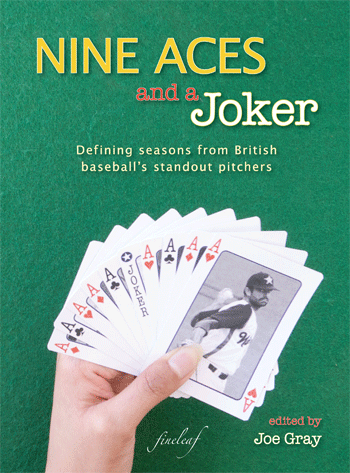
Nine Aces and a Joker: Defining seasons from British baseball’s standout pitchers was published by Project COBB several weeks back and is available both in print and as a Kindle eBook. Copies of the print version will be on sale for £12 at all three days of the National Baseball Championships, at Hemel Hempstead, this coming Bank Holiday weekend (come and see me if you would like to purchase one — I’ll be glued to the action on the newer diamond).

What about the Villa?: Forgotten figures from Britain’s pro baseball league of 1890, the first book to come out of Project COBB, will also be on sale (at a price of £10 when bought individually or for just £6 when bought in addition to Nine Aces and a Joker). This is also available in print via the publisher’s website.

First review now out

While, ordinarily, Matt Smith or I would be eager to review a book of this nature, in this instance — as we have both contributed chapters — we could not do so impartially. However, review copies have been sent to various outlets, and the race to get the first review up was won by tireless British baseball online commentator Michael Jones. His review, published by the UK Amercian Sports Fans website, can be found at this URL:

http://www.ukamericansportsfans.com/book-review-nine-aces-and-a-joker-by-joe-gray

One from the Present: Altercations

So it all kicked off on Sunday at Hemel, in the double-header between the Harlow Nationals and the Herts Falcos, but that was no surprise.

The Nationals were formed in 2011 when a core cluster of Falcons decided to break off from the cast. While I can’t find fault in the professional way in which the reigning champions were set up — particularly by the standards of an amateur sport — some unhappiness was almost inevitable.

Augmenting the rivalry, in terms of both personnel and competitiveness, is the fact that the Herts team has now added major players from the old Richmond squad, who might still feel aggrieved at their semi-final championship loss to Harlow last season.

All that was needed to spark a bench clearance yesterday was something as seemingly minor — to those not in the know about baseball’s deep-running rituals — as “pimping” a home run; that being the modern parlance for showboating.

Continue reading

One from the Present: Patience

I know my writing focus is normally on the top tier of British baseball, but sometimes the story is so good that a deviation from the norm is justified. Moreover, there was a need to smooth out the British baseball karma, and so after my look at “Frustration” from one game on 29 May, here is a consideration of “Patience” from another on that date. Continue reading

One from the Present: Frustration

If a physicist was to create an equation to predict the chance that a fair fly-ball would hit the top of the perimeter fence and bounce back into play, then factors that would probably feature in the modelling include layout of the field, trajectory of the ball, velocity on leaving the bat, air pressure, and wind speed and direction. She (yes, not all physicists are men) might want, for extra credits or some other perfectly valid reason, to tailor the formula for British baseball, in which case the existence of fencing in the first place would need to be established, as indeed would the material used. Continue reading

Keep the entries coming for the BBPC

The British Baseball Photography Competition (BBPC; run in conjunction with Project COBB Photography) has been showcasing the work of both experienced and novice photographers from the baseball community over the past two years.  The 2012 season sees the third running of the competition, and although it is still early days, it looks like it will be a challenge to top the total of 145 photos submitted in last year’s competition.

But the slow start is quite probably in large part due to the unpleasant weather we’ve endured (and the resulting lack of fixtures) during the opening weeks of the season. Cold, wet conditions do not make sports photographers eager to get their equipment out.

The good news is that with the glorious weather we are now enjoying, there should be games galore and no excuse to leave the camera at home. In addition, the submission process is now slicker than ever as the clever folks at BaseballSoftballUK have built a special online entry form.

The online entry form can be accessed by clicking HERE.

Once we get to October, a shortlist will be drawn up and published for a public vote, and the winner — who will receive £100 in photo vouchers — will be announced in November. For handy hints on how to please the judges, check out this article. Full competition rules can be found by clicking here.

One from the Past: “Balks”

Sports junkies are addicted to oddities, and a regular fix is offered by the abundance of individual incidents played out within North American organized baseball’s daily schedule, not to mention the global game. I count myself among the junkies’ number and, until half an hour ago, took pride in thinking that if there was a potential event that I had not seen with my own eyes, I had at least conceived of its possibility. But that was before I started browsing through some press cuttings for the Cobham Yankees in 1987.

On Sunday 10 May of that year, the Yankees played regional rivals the Sutton Braves in a league contest. The Yankees entered the seventh inning facing a 9-1 deficit but rallied for 8 runs in the frame to draw even. On an initial skim of the cutting I read the following:

The inning featured three base-hits by both Brad Thompson and Alan Smith, Cobham’s catcher and centrefielder.

There was my fix. An incredible occurrence. But then I did my sums and had a rapid come-down. For two players to get three hits in an inning, a minimum of 14 runs would need to score. Cursing the journalist who had been so cruelly inept, I re-read the words. And then I spotted something. My eyes had tricked me by vaulting a hyphen over a four-character gap. What the journalist actually wrote did add up; but, sadly, it was not going to get me my high:

The inning featured three-base hits by both Brad Thompson and Alan Smith, Cobham’s catcher and centrefielder.

Feeling a little ashamed, I meekly read on, but then suddenly realized why my eyes had been so prone to deception. The opening paragraph had promised an “ending so bizarre that nothing like it had been seen in the Southern League in years.” I had just been premature, I thought.

I read on. The Braves were not done yet: they rallied back to take a 12-9 lead into the bottom of the ninth. But the Yankees responded with 3 runs of their own and had runners on first and third with one out.

Was this it? A double comeback? It was probably very exciting to have been a part of, but 25 years on it was just not doing it for me. Again, I cursed the journalist. Again, I had erred.

So what was the bizarre ending then? Well, Cobham had Gene Hickman at bat, and Sutton decided to intentionally walk him, presumably to set up the force at home. As the journalist kindly explained for a readership who would, for the most part, have been unfamiliar with baseball’s finer points: “in order to walk Hickman, the Sutton pitcher had to pitch the ball outside the strike zone four times.”

Well he managed this once, but on the second pitch he “inexplicably halted his motion” and was adjudged to have balked. And this ended the game, as the winning run trotted home from third. A walk-off balk on a failed intentional base on balls attempt. Is there a stranger, or more embarrassing, way to end a game?

The Yankees also got the better of the Braves in the quarter-finals of that year’s national play-offs, on their way to securing a second championship in their record-setting run of three straight titles.

One from the Present: “Losing”

Neither team deserved to lose.

You don’t have to reach too deeply into the bag of diplomatic sports interview responses before you uncover the above gem. A sacred and universal tradition among interviewees dictates that it should be left close to the top of the bag, owing to the frequent need for its retrieval. In football, the unwritten code instructs one to return the phrase by nestling it between “they played a great game” and “they made it difficult for us early doors.”

The question of whether the statement can be substantiated from metaphysical first principles for a zero-sum game with only two possible outcomes,  such as a baseball match,  rarely gets the consideration that it merits. In other words, it’s bullshit — unless the game was in the infinitesimally small pool of contest in which the two teams were exactly even in their performance level.

But how about the phrases “neither moundsman deserved to lose” or “neither twirler deserved to lose”? (Both of them, incidentally, are making their debut on the Internet, or at least the portion of it accessible by the Google search engine. Try / it.) If the duellists both put in solid efforts that would on an average day get them a win, then it makes sense to say that neither deserved to be charged with a loss.

All of the above represents a circuitous way for me to say that I’m not being silly in writing the following:

In the opening game at Northbrooks Playing Fields last Sunday, neither pitcher deserved to lose.

Jamie Ratcliff twirled a shutout as the Harlow Nationals bested the Bracknell Blazers. The 18-year-old Brit gave up his first and only hit of the game when he was just two outs away from a no-hitter. It would be extremely difficult to make a case that he deserved the loss. His opponent, Henry Collins, also went the distance but gave up a run. You would feel irked in the Major Leagues if you gave up a solitary tally and still lost, but in British baseball it is almost unthinkable. A past victim of the “almost unthinkable” was Nic Goetz, whose one run given up in a complete game for Herts against Croydon on 30 May 2010 was one run too many.

In the game last Sunday, Collins — the only British born-and-bred winner of the Most Valuable Pitcher award in the past 10 years — gave up a pair of hits, a walk, and a run in the first inning, but over the next four frames the only damage to his pitching line was a bare single. In the sixth, he gave up a lead-off hit but seconds later erased the blemish with a well-executed pick-off play. Deeper into the inning, he gave up his only extra-base hit, to Edwin Alcanatara. It could be argued that he made a mistake with that pitch, but to the batter in question anything that doesn’t bounce (and even some that do) could potentially end up being branded a “mistake”, such is the unorthodox and ever-thrilling interpretation of the strike-zone by the Dominican gentle giant, last year’s triple-crown winner.

Perhaps I have missed the point. I should not have become involved in lamenting the unjustness — the losing pitcher and his squad-mates were capable of looking after that themselves. Instead, I should have been celebrating this rare scoreline. But I felt like throwing a pitch in the dirt myself, and as a fan of this marvellous sport I am sure you had little trouble in blocking it.