Category Archives: Project COBB

News and information relating to the Project for the Chronicling of British Baseball

Vote now in the British Baseball Photography Competition

Voting has just opened for the 2012 British Baseball Photography Competition. To see the gallery of 10 entries shortlisted by the judging panel and to cast your vote, CLICK HERE.

One vote will be accepted per email address and the ballot will close at 11.59pm on 16 November.

One from the Past: Classic pre-WWII finals in British Baseball

On 28 March 2009 I published an article describing the six classic national finals of British baseball’s post-war era, where a classic is simplistically defined (for reasons justified in the original piece) as one where the deciding game [a] went to extra innings or [b] had a winning margin of a single run. That article noted that there were also six finals in the pre-World War II period that would be defined in this way as having classic status.

I’ve been scrambling round for several years now, trying to piece together details of those earlier six finals, and below I present the still-incomplete findings.

For available details on all pre-World War II national finals, click here.

Continue reading

Seven more individuals inducted into British Baseball Hall of Fame

The fourth annual class of the British Baseball Hall of Fame (BBHoF) sees seven more inductees announced: Bill Dawber, John Devey, Michael Harrold, RG Knowles, Simon Pole, Terry Warner, and Max “Lefty” Wilson. This brings the total number of enshrinees to 18.

Photos and full bios for each of these individuals, as well as the previously elected inductees, can be found on the BBHoF web page, and abbreviated details are given below.

Bill Dawber
In a career that spanned five decades, Bill Dawber was one of the few players in the London area to shine on the baseball diamond both before World War II and after, developing into arguably the region’s best player in the 1950s. A young member of the professional London Major Baseball League’s Romford Wasps, Dawber was part of a club that made the national finals in 1937. In 1952, Dawber’s excellence was singularly recognized in the south of England. That year, he was the only player from the region chosen to represent England on a 15-man squad that travelled to play The Netherlands. In 1952, Dawber was also picked as a member of an all-England side that played in a tournament against Spain and a US Air Force team. Dawber continued to play into his 50s, retiring in 1972.

John Devey
A dominant two-way player in the first professional baseball league in Great Britain history, the British-born John Devey not only led the league in batting but also paced the circuit in wins on the mound. His performance powered his club, Aston Villa, to a 17–8 record and a league championship. The league featured two former Major Leaguers, four former or future American minor leaguers and a host of other players with considerable experience in the United States. Beyond his baseball exploits, Devey is arguably one of the greatest all-around athletes to have competed on the diamond in Great Britain. He played football for England and was a regular for the Warwickshire county cricket team.

Michael Harrold
Michael Harrold was the Great Britain national team’s longest tenured manager, leading the squad to a European title in 1988 and the juniors to a championship in 1993. His exceptional career also included stints as a distinguished player at both the national and domestic levels, as well as success as a manager in domestic league play. In addition to his work on and around the field, Harrold was a long-time administrator. Among his many roles, he served as British Baseball Federation president and a member of the British Olympic committee.

RG Knowles
Richard George (RG) Knowles was pivotal in developing the first regular baseball played in London. A comedian by trade, Knowles rounded up fellow performers and began setting up games in 1889 in Battersea Park. His efforts led to the establishment of the London Thespians – one of England’s first dominant teams. As player–manager of the Thespians, Knowles led the club to national championships in 1893 and 1894. The Thespians were the first team to win multiple British titles. Backed by Knowles’s work, Thespian home games were known to sometimes attract crowds in the thousands. Beyond his club, he also helped form the London Baseball Association.

Simon Pole
During his decade-long British career, no player put up better statistics as either a pitcher or a hitter than Simon Pole. From 1999 until 2008, he boasted a career .454 batting average, with 35 home runs and 224 runs batted in. According to Project COBB, those are career bests for that period. He led the country’s top league in home runs three times and topped the circuit in batting twice. In 2005, Pole won the “triple crown” with a .571 average, six home runs, and 42 runs batted in. He was no less impressive on the mound. His 2.11 earned-run average was the best of any player during the span of his career. A native Australian, Pole represented his adopted country internationally, playing for Great Britain in six events including the 2005 European Championship A-Pool.

Terry Warner
In a baseball career that lasted nearly 60 years, Terry Warner consistently shined as an all-around player in domestic competition and, in 1967, delivered one of Great Britain’s most important all-time international pitching performances. Warner won two national titles with Thames Board Mills. Along with his on-field exploits, Warner also invested numerous years into teaching the game. He was a coach for Great Britain when they took on the Dutch at Crystal Palace Football Club’s stadium in 1965 and he managed the team in 1968. In 1984, Warner skippered the Croydon Bluejays to a national title.

Max “Lefty” Wilson
Max “Lefty” Wilson is the only Major Leaguer to have pitched a team to a British national championship. He played in Great Britain during the heyday of professional baseball in the late 1930s. In 1936, he pitched for the Catford Saints in the London Major Baseball League. His performance was so impressive that fellow future Major Leaguer Roland Gladu dubbed the left-hander the best pitcher in the country. The next season, Wilson moved to the north of England to play for Hull. There, he was treated as a hero. The Hull Daily Mail called him a “pitching genius” in its 10 May 1937 edition. He led the club to the national championship that year, producing one of the greatest finals performances in British history.


 

British Baseball Hall of Fame to induct seven more individuals next week

On the 9th of this month – the now-traditional second Tuesday of October for the announcement of the British Baseball Hall of Fame’s annual class – seven more individuals will be enshrined, bringing the total number of inductees to 18.

Three people – Ross Kendrick, Sir John Moores, and Norman Wells – were inducted in the first class back in 2009. They were joined by a set of five in 2010, and then three more individuals in 2011. The 2012 class will be the biggest yet and includes representatives from across the game’s history on British shores.

The 2012 class will be jointly announced on www.baseballgb.co.uk and www.britishbaseball.org.

Baseball finals offer ideal chance for late-season photography

The British Baseball Photography Competition (BBPC; run in conjunction with Project COBB Photography) is accepting entries till the end of September, but with photographic opportunities now running out, it’s an excellent time to be capitalising on the last remaining events in the calendar and also to go back through the albums you have from earlier in the season.

So choose your best 24 shots and submit them, via the specially built online entry form, to be in with a chance to scoop the £100 of photographic vouchers on offer as the first prize. The online entry form can be accessed by clicking HERE.

Once we get to October, a shortlist will be drawn up and published for a public vote, and the winner — who will receive £100 in photo vouchers — will be announced in November. For handy hints on how to please the judges, check out this article. Full competition rules can be found by clicking here.

One from the Past: Gaps

This year’s National Baseball Championship will represent the 100th anniversary of, well, nothing. Starting in 1912, British baseball experienced a 22-year period without an official national final. The title deciders that bookended this lapse were both spectacular, at least judging by their 1-run winning margins, but, regardless of that, even the most meagre of British baseball appetite would have been left far from the point of satiation during this period of the game’s history.

Anniversaries are historically easy ways of generating promotional copy for almost anything, but this hiatus does not provide much of a fulcrum with which to lever publicity. If you push down on one end of plank of wood that is lying on the ground, the other end’s coordinates are not going to be overly troubled.

Still, we should at least be reminded to not take what we do have for granted, when the British baseball community gathers in Hertfordshire this bank holiday weekend.

The only event that historians are aware of from the barren field of 1912-1933 that comes close to being considered as a national final is a game that took place in 1926 at Stamford Bridge between Chipping Norton and an all-star team from London. A Daily Mail scribe who reported on the contest branded it the “British baseball championship”, and that is certainly how you’ll find the game, which Chipping Norton won, being remembered if you ever visit Chippy’s local history museum to take in its wonderful baseball exhibition. However, without any evidence of a qualifying structure underpinning the clash it is difficult to see how it can be considered anything more than a novelty. Moreover, the Daily Mail article must be taken with a hypertension-inducing quantity of salt. It adds a fascinating prequel to the Abner Doubleday farce by stating that he “was born at Wootton, near Chipping Norton, and took the game to the United States.” This Doubleday myth was debunked in the American press much more swiftly than the more famous one was.

Finally, if we set our backward-gazing power not to 100 years but rather a solitary season, there is more scope for reflection, as Michael Jones found out in his latest post on the UK American Sports Fans website.

One from the Present: Championships

This article is all about the historical context of the upcoming National Baseball Championships, specifically with regard to the top-tier level that is the National Baseball League. We now know which four teams will contest the finals, and their rosters are being frantically finalized behind the scenes as I write, but what is at stake from a historical angle?

Continue reading

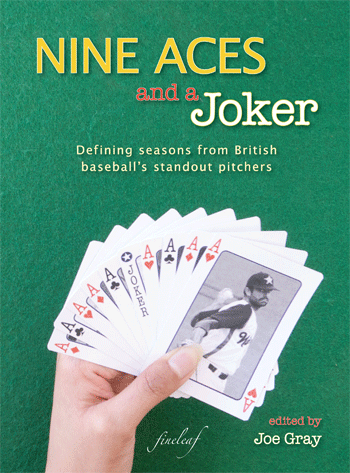
Nine Aces and a Joker: Purchasing information and details of first review

Nine Aces and a Joker: Defining seasons from British baseball’s standout pitchers was published by Project COBB several weeks back and is available both in print and as a Kindle eBook. Copies of the print version will be on sale for £12 at all three days of the National Baseball Championships, at Hemel Hempstead, this coming Bank Holiday weekend (come and see me if you would like to purchase one — I’ll be glued to the action on the newer diamond).

What about the Villa?: Forgotten figures from Britain’s pro baseball league of 1890, the first book to come out of Project COBB, will also be on sale (at a price of £10 when bought individually or for just £6 when bought in addition to Nine Aces and a Joker). This is also available in print via the publisher’s website.

First review now out

While, ordinarily, Matt Smith or I would be eager to review a book of this nature, in this instance — as we have both contributed chapters — we could not do so impartially. However, review copies have been sent to various outlets, and the race to get the first review up was won by tireless British baseball online commentator Michael Jones. His review, published by the UK Amercian Sports Fans website, can be found at this URL:

http://www.ukamericansportsfans.com/book-review-nine-aces-and-a-joker-by-joe-gray

One from the Present: Altercations

So it all kicked off on Sunday at Hemel, in the double-header between the Harlow Nationals and the Herts Falcos, but that was no surprise.

The Nationals were formed in 2011 when a core cluster of Falcons decided to break off from the cast. While I can’t find fault in the professional way in which the reigning champions were set up — particularly by the standards of an amateur sport — some unhappiness was almost inevitable.

Augmenting the rivalry, in terms of both personnel and competitiveness, is the fact that the Herts team has now added major players from the old Richmond squad, who might still feel aggrieved at their semi-final championship loss to Harlow last season.

All that was needed to spark a bench clearance yesterday was something as seemingly minor — to those not in the know about baseball’s deep-running rituals — as “pimping” a home run; that being the modern parlance for showboating.

Continue reading